

When we think of human ancestors, we typically think of Australopithecus afarensis, famously known as ‘Lucy’. This is because, for a long time, we believed that species like Lucy walked the earth alone about 3 to 4 million years ago.
However, in 2001, a shocking fossil discovered in Kenya shattered this stereotype. It lived at the same time as Lucy but looked completely different: the arrival of Kenyanthropus platyops.
Today, we will dig into this mysterious human ancestor, moving beyond the heated academic debates to its potential status as the first ‘tool maker’.
1. A Shocking Appearance: “Lucy Was Not Alone”
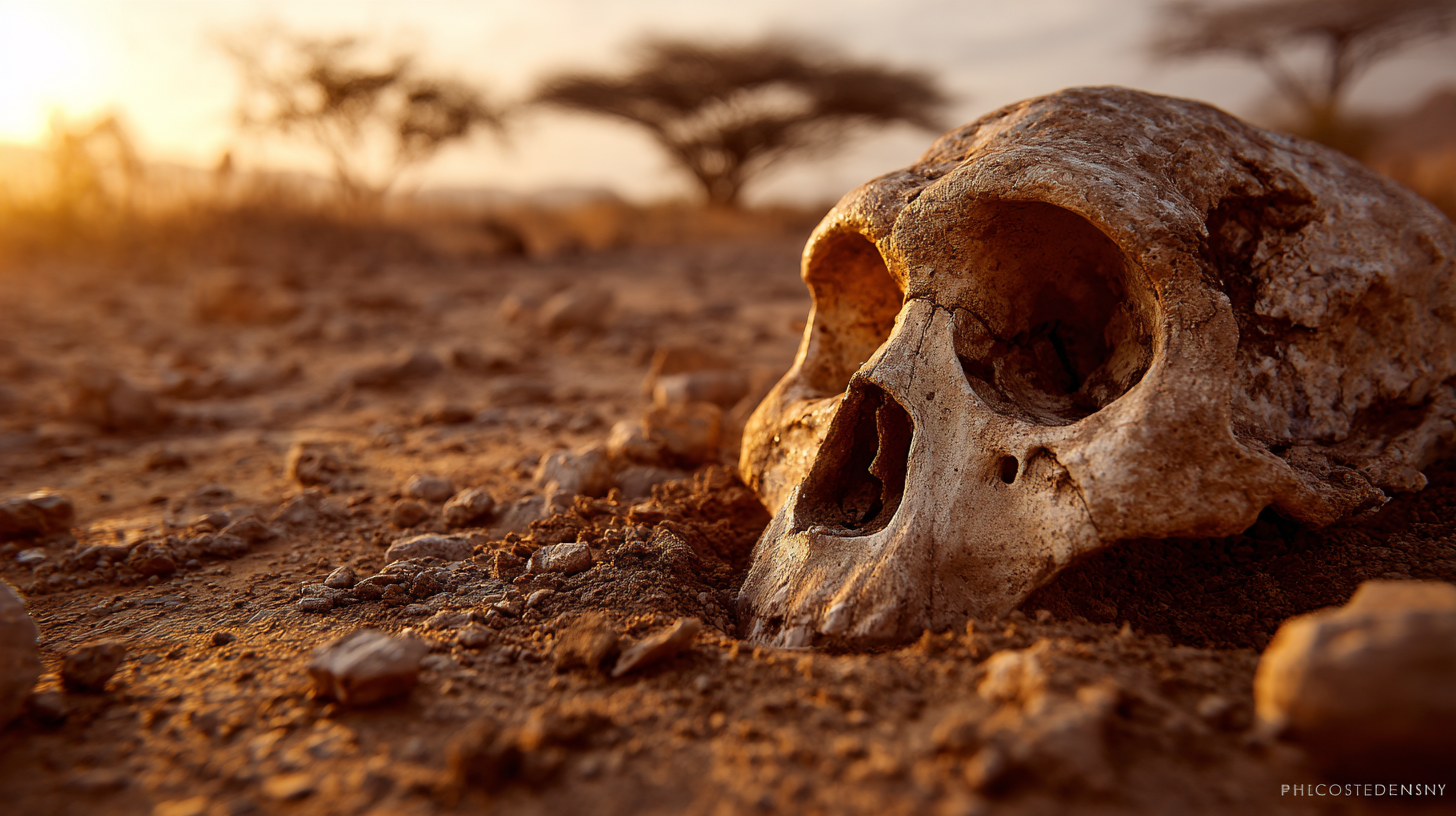
In 1999, a peculiar skull fossil (KNM-WT 40000) was discovered by Justus Erus in the Lomekwi region west of Lake Turkana, Kenya. In 2001, a research team led by Dr. Meave Leakey named it a new genus, ‘Kenyanthropus’ (meaning “Man of Kenya”), and the species ‘platyops’ (meaning “flat face”), stating it was completely different from the existing Australopithecus.
Their most distinctive feature is a ‘Flat face’.
- Lucy (Australopithecus): The mouth protrudes forward like a chimpanzee.
- Kenyanthropus: The cheekbones (zygomatic process) are positioned forward (over the premolars), and the area under the nose drops vertically, creating an overall flat facial appearance.
This discovery revealed to the world that ‘Lucy’ did not live alone in Africa 3.5 million years ago; rather, multiple human ancestors with different faces coexisted.
2. 20 Years of Debate: “A New Species or a Crushed Fossil?”
However, the academic reaction was not entirely welcoming. In 2003, renowned paleoanthropologist Tim White raised a strong question:
“This is not a new species, but merely a severely crushed Australopithecus.”
Professor White pointed out that the discovered skull had been broken into over 1,100 pieces by geological pressure during the fossilization process (Expanding Matrix Distortion). He argued that the skull was flattened by pressure, leading to the misconception that it originally had a flat face.
(Note: Including a photo of the fragmented skull from the paper here would be effective in visually demonstrating the severity of the distortion.)
This controversy lasted for over 20 years. It seemed Kenyanthropus might remain a question mark rather than making it into the textbooks.
3. Victory of Science: The Truth Revealed by CT Scans (2024)
In 2024, cutting-edge technology put an end to this long debate. Hanegraef and colleagues used CT scanning and Geometric Morphometrics to digitally “un-crush” and restore the fossil.
The result was astonishing.
- Even after perfectly correcting for the distortion, Kenyanthropus retained a form distinctly different from Australopithecus.
- In particular, the position of the cheekbone (anterosuperior) and the vertical slope under the nose (orthognathic subnasal clivus) were proven to be unique anatomical features unrelated to the crushing.
Finally, Kenyanthropus was confirmed as a distinct, independent species, not a variation of Lucy.
4. The Twist: Lucy Might Not Be Our Ancestor?
The resurrection of Kenyanthropus is crucial for another real reason. It might change the candidate for the direct ancestor of modern humans (genus Homo).
Dr. Leakey’s team noted that the ‘flat face’ of Kenyanthropus surprisingly resembles the later appearing Homo rudolfensis (KNM-ER 1470).
- Existing Theory: Australopithecus (Lucy) → Homo (Us)
- New Hypothesis: Kenyanthropus → Homo rudolfensis → Homo (Us)
If this hypothesis is correct, our beloved ‘Lucy’ might not be our direct grandmother, but a distant cousin who branched off the evolutionary tree and went extinct.
5. Hands Before Brains? (The First Tool Maker)
What makes Kenyanthropus even more special are the ‘stone tools’ found where they lived.
In 2015, stone tools dating back 3.3 million years were discovered at the Lomekwi 3 site near the Kenyanthropus fossil. This is 700,000 years older than the previously known oldest stone tools (Oldowan, 2.6 million years ago). The only hominin living in this region at that time was Kenyanthropus.
This discovery is shocking because of their ‘Hand Motor Control’.
- The discovered stone tools were not simply bashed together like chimpanzees do.
- They used ‘passive hammer’ or ‘bipolar’ techniques, using two hands to hold the stone and strike at precise angles.
Researchers concluded from this that “neural abilities to precisely control the hands evolved before the brain dramatically increased in size (before the appearance of the genus Homo).” Kenyanthropus might have already been a skilled technician.
6. What Did They Eat? (Flexible Diet)
So, what kind of environment did they live in? Stable isotope analysis of tooth enamel reveals that Kenyanthropus was ‘not a picky eater’.
- Their ancestor, Au. anamensis, ate mostly trees or shrubs (C3 plants).
- However, Kenyanthropus consumed a mix of trees as well as grasses and sedges (C4 plants).
This shows that they flexibly adapted their diet to survive in an environment where forests were shrinking and grasslands were expanding.
7. (Caution!) A Confusing Name: Kenyapithecus
Lastly, a fact check! While studying, you might come across a fossil with a similar name, ‘Kenyapithecus’.
- Kenyapithecus: An ape from about 14 million years ago.
- Kenyanthropus: A hominin (human ancestor) from about 3.5 million years ago.
They are completely different beings separated by a 10-million-year time gap, so don’t get confused!
Conclusion: Human Evolution Was a Maze, Not a Straight Line
The existence of Kenyanthropus platyops teaches us an important fact. Human evolution was not a ladder leading up in a single line, but a ‘lush bush’ where numerous species competed and coexisted with their own survival strategies (flat faces, tool use, omnivory, etc.).
Perhaps, somewhere on the grasslands of East Africa 3.5 million years ago, the protagonist with the ‘flat face’ breaking heavy stones to make tools was our true grandfather.
References
- Benefit, B. R., et al. (1986). Miocene fossil cercopithecoids from Kenya. American Journal of Physical Anthropology, 69(4), 441-464.
- Cerling, T. E., et al. (2013). Stable isotope-based diet reconstructions of Turkana Basin hominins. Proceedings of the National Academy of Sciences, 110(26), 10501-10506.
- Hanegraef, H., et al. (2024). Mid-Pliocene hominin diversity revisited. Comptes Rendus Palevol, 23(29), 453-464.
- Harmand, S., et al. (2015). 3.3-million-year-old stone tools from Lomekwi 3, West Turkana, Kenya. Nature, 521(7552), 310-315.
- Leakey, M. G., et al. (2001). New hominin genus from eastern Africa shows diverse middle Pliocene lineages. Nature, 410(6827), 433-440.
- Pickford, M. (1985). A New Look at Kenyapithecus based on Recent Discoveries in Western Kenya. Journal of Human Evolution, 14(2), 113-143.
- Pickford, M., et al. (2001). The geological and faunal context of Late Miocene hominid remains from Lukeino, Kenya. Comptes Rendus de l’Académie des Sciences-Series IIA-Earth and Planetary Science, 332(2), 145-152.
- Scott, R. S., et al. (2005). Dental microwear texture analysis shows within-species diet variability in fossil hominins. Nature, 436(7051), 693-695.
- White, T. D. (2003). Early Hominids—Diversity or Distortion? Science, 299(5615), 1994-1997.