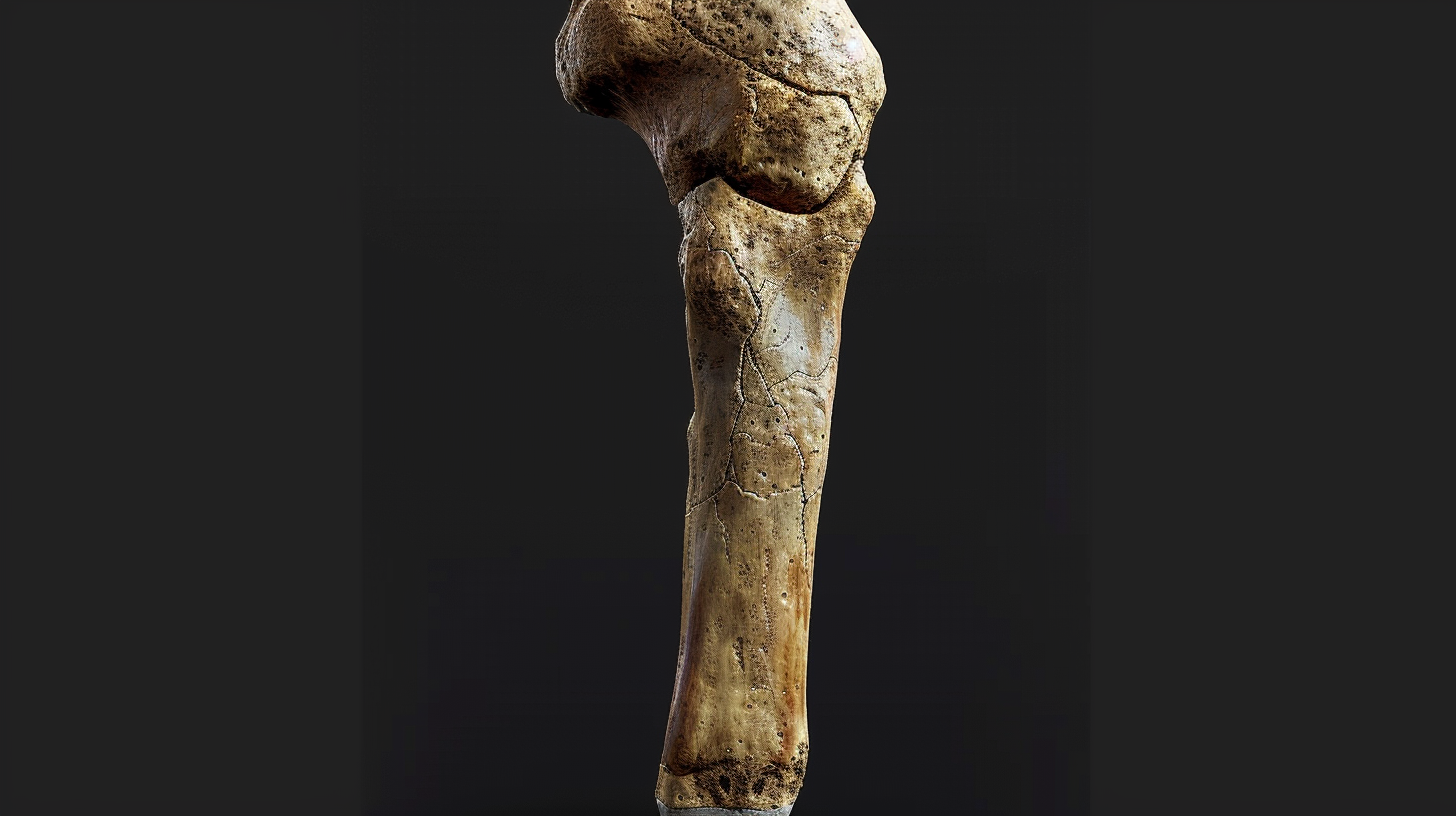


Hello! Today, I want to talk about our ancestor, ‘Homo erectus,’ who roamed the widest lands for the longest time in human evolutionary history.
Please forget the illustration of the stooped ape you saw in textbooks. The Homo erectus revealed by recent studies might have been a ‘capable individual’ comparable to modern humans, and perhaps even an unexpected ‘artist.’
I will now begin the real story of those who left Africa 1.8 million years ago, conquered the Eurasian continent, and survived until just 100,000 years ago.
1. Small Brain but ‘Model’ Body Proportions? (The Unexpected Charm)
The most surprising thing when first encountering Homo erectus is their ‘unbalanced’ appearance.
‘Skull 5’ found in Dmanisi, Georgia, was shocking. The brain volume was only about 546 cm3, comparable to an australopithecine, but the face was huge and protruding, like a gorilla’s2222. It shattered the evolutionary formula that “as the brain gets bigger, the face gets smaller.”
However, from the neck down, it is completely different. Looking at the ‘Nariokotome Boy’ fossil found in Kenya, he is tall with long limbs. He already possessed body proportions almost identical to modern humans. This means that the body evolved perfectly first to escape Africa, even before the brain improved.
2. A Hunter Scarier Than a Cheetah (Endurance Hunting)
How did Homo erectus survive in the harsh wild with that small brain? The secret was ‘sweat’ and ‘persistence.’
They were the first humans to shed fur and sweat to cool down their body temperature, just like us. Furthermore, with elongated legs, large gluteal muscles, and elastic arches in their feet, their bodies were optimized for being runners.
- [Interesting Fact] They were masters of ‘Persistence Hunting’. They couldn’t run fast like a lion or cheetah, but they could chase their prey for hours under the scorching midday sun until the animal exhausted itself. The prey would eventually collapse from heatstroke, and Erectus could easily secure the meat.
3. The First Human Artist? (Mysterious Doodles)
They didn’t just solve the problem of eating and living. A single shell found at the Trinil site in Java, Indonesia, turned the academic world upside down.
It wasn’t just a shell left over from a meal. Traces were found where they used a shark’s tooth as a tool to carve an elaborate geometric zigzag pattern (M-shape, N-shape) onto the surface of the shell.
- [Learn More] This dates back to approximately 500,000 years ago, which is at least 300,000 years earlier than the artistic activities of modern humans. This shows they were not just animals living by instinct, but ‘the first artists’ capable of expression and abstract thought.
4. Could They Speak? (Ready Brain, Unready Body)
Then, did they have conversations like us? This is a hot potato in academia.
Analyzing the interior of the Homo erectus skull reveals that ‘Broca’s area,’ which is responsible for language, is raised, suggesting the brain structure was ready for speech. However, an investigation of the vertebrae revealed a twist. The neural canal of the thoracic vertebrae was much narrower than that of modern humans.
- [Key Point] This implies they did not have the respiratory control ability developed enough to regulate the fine muscles of the rib cage for complex pronunciation. They likely communicated through gestures, simple sounds, or primitive forms like humming rather than fluent language.
5. The Last Survivors, and Their Neighbors
Homo erectus survived much longer than we thought. According to studies of the Ngandong site in the Solo River basin of Java, Indonesia, they survived until just 117,000 to 108,000 years ago.
What is even more surprising is that they were not alone during that time.
- [Lord of the Rings?] When Erectus lived on Java, the short-statured ‘Hobbit’ people (H. floresiensis) lived on the nearby island of Flores , and H. luzonensis lived in the Philippines. Genetic analysis even suggests that the mysterious Denisovans arrived in Southeast Asia early on20. Earth 100,000 years ago might have been like a fantasy movie world where various human species coexisted.
Conclusion: The Victor of Persistence
Homo erectus was not simply a bridge to modern humans. They were successful humans who adapted to the global environment for nearly 2 million years, handling fire, making tools, crossing oceans, and cultivating their own culture.
The DNA of persistence and challenging the new still flows in our bodies. Homo erectus was the very starting point of the civilization we enjoy today.
References
- Antón, S. C. (2003). Natural history of Homo erectus. Yearbook of Physical Anthropology, 46, 126–170.
- Bramble, D. M., et al. (2004). Endurance running and the evolution of Homo. Nature, 432, 345–352.
- Dubois, E. (1894). Pithecanthropus erectus: Eine menschenähnliche Übergangsform aus Java. Landesdruckerei.
- Ferring, R., et al. (2011). Earliest human occupations at Dmanisi (Georgian Caucasus) dated to 1.85–1.78 Ma. Proceedings of the National Academy of Sciences, 108(26), 10432–10436.
- Goren-Inbar, N., et al. (2004). Evidence of hominin control of fire at Gesher Benot Ya’aqov, Israel. Science, 304(5671), 725–727.
- Hou, Y., et al. (2000). Mid-Pleistocene Acheulean-like stone technology of the Bose Basin, South China. Science, 287(5458), 1622–1626.
- Joordens, J. C. A., et al. (2015). Homo erectus at Trinil on Java used shells for tool production and engraving. Nature, 518, 228–231.
- Leakey, M. G., et al. (2012). New fossils from Koobi Fora in northern Kenya confirm taxonomic diversity in early Homo. Nature, 488, 201–204.
- Lordkipanidze, D., et al. (2013). A complete skull from Dmanisi, Georgia, and the evolutionary biology of early Homo. Science, 342(6156), 326–331.
- Montagu, M. F. A. (1944). Review: The skull of Sinanthropus pekinensis; A comparative study on a primitive hominid skull by Franz Weidenreich. American Anthropologist, 46(3), 402–405.
- Rasmussen, D. T. (1995). Review: Early Pleistocene youth [Review of the book The Nariokotome Homo erectus Skeleton, by A. Walker & R. Leakey]. Current Anthropology, 36(3), 537–539.
- Rizal, Y., et al. (2020). Last appearance of Homo erectus at Ngandong, Java, 117,000–108,000 years ago. Nature, 577, 381–385.
- Schwartz, J. H., et al. (2014). Comment on “A complete skull from Dmanisi, Georgia, and the evolutionary biology of early Homo“. Science, 344(6182), 360.
- Wood, B., & Grabowski, M. (2015). Macroevolution in and around the hominin clade. In E. Serrelli & N. Gontier (Eds.), Macroevolution (Interdisciplinary Evolution Research 2, pp. 345–376). Springer International Publishing.
- Zollikofer, C. P. E., et al. (2014). Response to comment on “A complete skull from Dmanisi, Georgia, and the evolutionary biology of early Homo“. Science, 344(6182), 360.