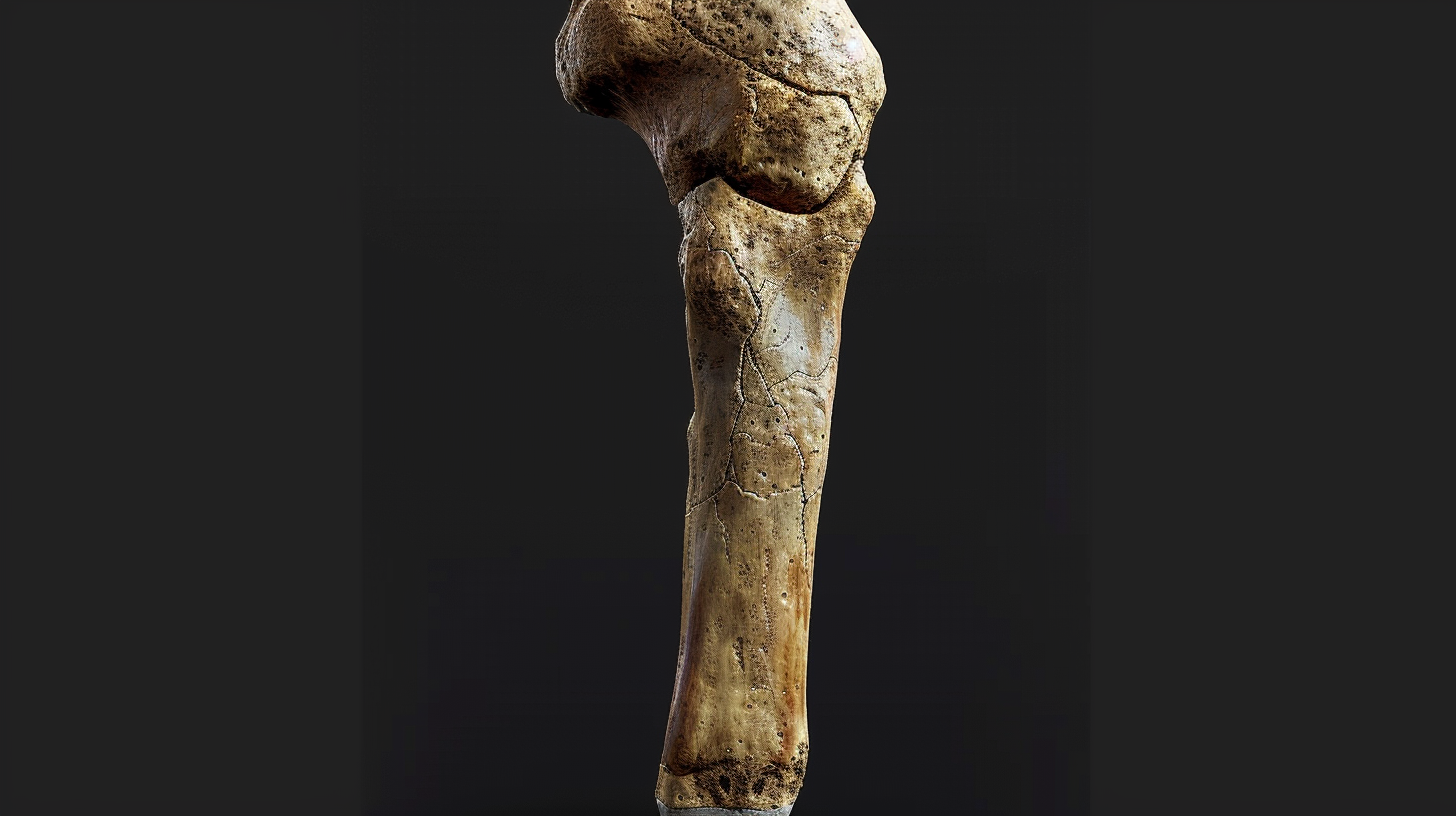


The most complex and fiercely debated period in the history of human evolution is the ‘Middle Pleistocene.’ Homo heidelbergensis, the species that dominated this era, was not a simple primitive human. They possessed massive brains and powerful bodies, practiced sophisticated hunting, and knew how to mourn their dead.
Based on recent genetic analyses and radiocarbon dating results, we thoroughly dissect their identity and lifestyle.
1. Brain and Body: They Were Giants (Physical Morphology)
Homo heidelbergensis displays physical characteristics far more advanced than the preceding Homo erectus.
- Rapid Increase in Brain Volume: While the average brain volume of Homo erectus was about 973cc, the humans of this era (Broken Hill, Petralona, Bodo, etc.) averaged 1,206cc. This signifies a quantum leap in intelligence.
- Cranial Shape: The face was still large and broad. The brow ridge (supraorbital torus) was unbroken, forming a thick, double-arched shape across both eyes. In particular, the fossils from the ‘Sima de los Huesos (SH)’ site in Spain show the center of the face projecting outward, exhibiting early characteristic features of Neanderthals.
- Powerful Physique (Wide Bauplan): Analysis of 24 long bones found at the SH site estimates the average height for males at 175.3 cm and females at 160.6 cm. They possessed wide pelvises and thick bones, suggesting they had a ‘Wide Bauplan’ with immense muscle mass and body weight (averaging over 69 kg).
2. Hunting and Technology: The Emergence of Apex Predators (Behavior & Technology)
They went beyond simple foraging, possessing organized hunting capabilities and tool-making skills.
- The Schöningen Spears: Three wooden spears discovered in Schöningen, Germany (approx. 400,000 years old), are among the most astonishing discoveries in human history. Made from spruce, these spears are 1.8 to 2.3 meters long and crafted with the center of gravity in the front third, making them suitable for throwing. Found alongside more than 10 horse bones, they prove that these humans organized to hunt large animals.
- Fire Use: Evidence for the ‘habitual’ use of fire in Europe appears around 300,000 to 400,000 years ago. At sites like Beeches Pit and Terra Amata, burnt stones and bones have been found, showing they controlled fire to survive cold climates and cook food.
- Construction of Shelter: At the Terra Amata site in Nice, France, traces of oval huts and hearths were discovered. This indicates they constructed dwellings and moved seasonally.
3. Death and Ritual: The Dawn of Symbolic Behavior (Mortuary Practice)
Homo heidelbergensis was likely the first human species to recognize death and treat it in a special way.
- The Secret of the Bodo Skull: The Bodo skull found in Ethiopia (approx. 600,000 years old) bears distinct cut marks made by stone tools. Researchers analyze this not merely as cannibalism, but potentially as part of a post-mortem defleshing ritual.
- The First Funeral? (Sima de los Huesos): In a deep cave pit in Spain (SH), the bodies of at least 28 individuals were piled up. This location was not a living space, and there are few signs of carnivores dragging them in. Notably, a single handaxe made of red quartzite (nicknamed ‘Excalibur’) was found here. This is interpreted as the first votive offering intentionally thrown in with the bodies.
4. Truth Revealed by Genetics: The Family Tree Turned Upside Down (Genetics & Taxonomy)
Recent DNA analysis and dating have shaken the existing classification system.
- The Mitochondrial DNA Reversal: Mitochondrial DNA from SH fossils (approx. 430,000 years old) was found to be closer to Denisovans than Neanderthals. However, Nuclear DNA analysis confirmed they were indeed early Neanderthals. This suggests that long ago, genes flowed in from an unknown human species, or that the maternal lineage of later Neanderthals was replaced by a group arriving from Africa.
- The Young Age of Broken Hill (Kabwe 1): The Broken Hill skull from Africa, often considered the type specimen for H. heidelbergensis (or H. rhodesiensis), was previously thought to be 500,000 years old but has been redated to a much younger approx. 299,000 years ago. This raises the possibility that they were not a distant ancestor, but a distinct group that coexisted with early Homo sapiens.
- The Emergence of ‘Homo bodoensis’: To resolve this confusion, some scholars propose reclassifying the European fossils as ‘Early Neanderthals’ and naming the African fossils Homo bodoensis, redefining them as the direct ancestors of modern humans.
Conclusion: Where Did We Come From?
Homo heidelbergensis (or Homo bodoensis and early Neanderthals) represents the crucial ‘waist’ of human evolution. With brains exceeding 1,200cc, they crafted sophisticated spears to hunt, used fire to overcome the cold, and performed rituals for their dead comrades.
They were the roots of human diversity and the forgotten giants that branched out into Homo sapiens (modern humans) in Africa, Neanderthals in Europe, and Denisovans in Asia.
References
- Schoetensack, O. (1908). Der Unterkiefer des Homo heidelbergensis aus den Sanden von Mauer bei Heidelberg. W. Engelmann.
- De Lumley, H. (1969). A Paleolithic Camp at Nice. Scientific American, 220(5), 42–51.
- White, T. D. (1986). Cut Marks on the Bodo Cranium: A Case of Prehistoric Defleshing. American Journal of Physical Anthropology, 69(4), 503–509.
- Arsuaga, J. L. (1997). The Sima de los Huesos crania (Sierra de Atapuerca, Spain). A comparative study. Journal of Human Evolution, 33(2-3), 219–281.
- Rightmire, G. P. (1998). Human Evolution in the Middle Pleistocene: The Role of Homo heidelbergensis. Evolutionary Anthropology, 6(6), 218–227.
- Thieme, H. (1997). Lower Palaeolithic hunting spears from Germany. Nature, 385, 807–810.
- Wegner, D. (2007). Der Unterkiefer des Homo heidelbergensis von Mauer: Ein Fund von Weltrang?. (O. Schoetensack 1908 )
- McBrearty, S. (2000). [Review of the book] Boxgrove: A Middle Pleistocene Hominid Site…. Geoarchaeology, 15(8), 819–833.
- Martinez, I. (2004). Auditory capacities in Middle Pleistocene humans from the Sierra de Atapuerca in Spain. Proceedings of the National Academy of Sciences, 101(27), 9976–9981.
- Rightmire, G. P. (2004). Brain Size and Encephalization in Early to Mid‐Pleistocene Homo. American Journal of Physical Anthropology, 124(2), 109–123.
- Carbonell, E. (2006). The emergence of a symbolic behaviour: the sepulchral pit of Sima de los Huesos, Sierra de Atapuerca, Burgos, Spain. Comptes Rendus Palevol, 5(1-2), 155–160.
- Roebroeks, W. (2011). On the earliest evidence for habitual use of fire in Europe. Proceedings of the National Academy of Sciences, 108(13), 5209–5214.
- Stringer, C. (2012). The Status of Homo heidelbergensis (Schoetensack 1908). Evolutionary Anthropology, 21(3), 101–107.
- Meyer, M. (2014). A mitochondrial genome sequence of a hominin from Sima de los Huesos. Nature, 505, 403–406.
- Pablos, A. (2014). Human calcanei from the Middle Pleistocene site of Sima de los Huesos (Sierra de Atapuerca, Burgos, Spain). Journal of Human Evolution, 76, 63–76.
- Arsuaga, J. L. (2015). Postcranial morphology of the middle Pleistocene humans from Sima de los Huesos, Spain. Proceedings of the National Academy of Sciences, 112(37), 11524–11529.
- Posth, C. (2017). Deeply divergent archaic mitochondrial genome provides lower time boundary for African gene flow into Neanderthals. Nature Communications, 8, 16046.
- Grün, R. (2020). Dating the skull from Broken Hill, Zambia, and its position in human evolution. Nature, 580, 372–375.
- Roksandic, M. (2021). Resolving the “muddle in the middle”: The case for Homo bodoensis sp. nov. Evolutionary Anthropology.