
When we talk about the ‘first humans’ or our ‘human ancestors,’ the first name that usually comes to mind is ‘Lucy,’ the famous Australopithecus afarensis.
But would you believe there was a being that stood on two feet and walked the earth 6 million years ago—a staggering 2 million years before Lucy lived (3 Ma)?
Today, we dig into everything about Orrorin tugenensis, the protagonist filling the ‘missing link’ in human evolution.
1. 🌅 6 Million Years Ago: The ‘Original Man’ Opens the Dawn in Kenya
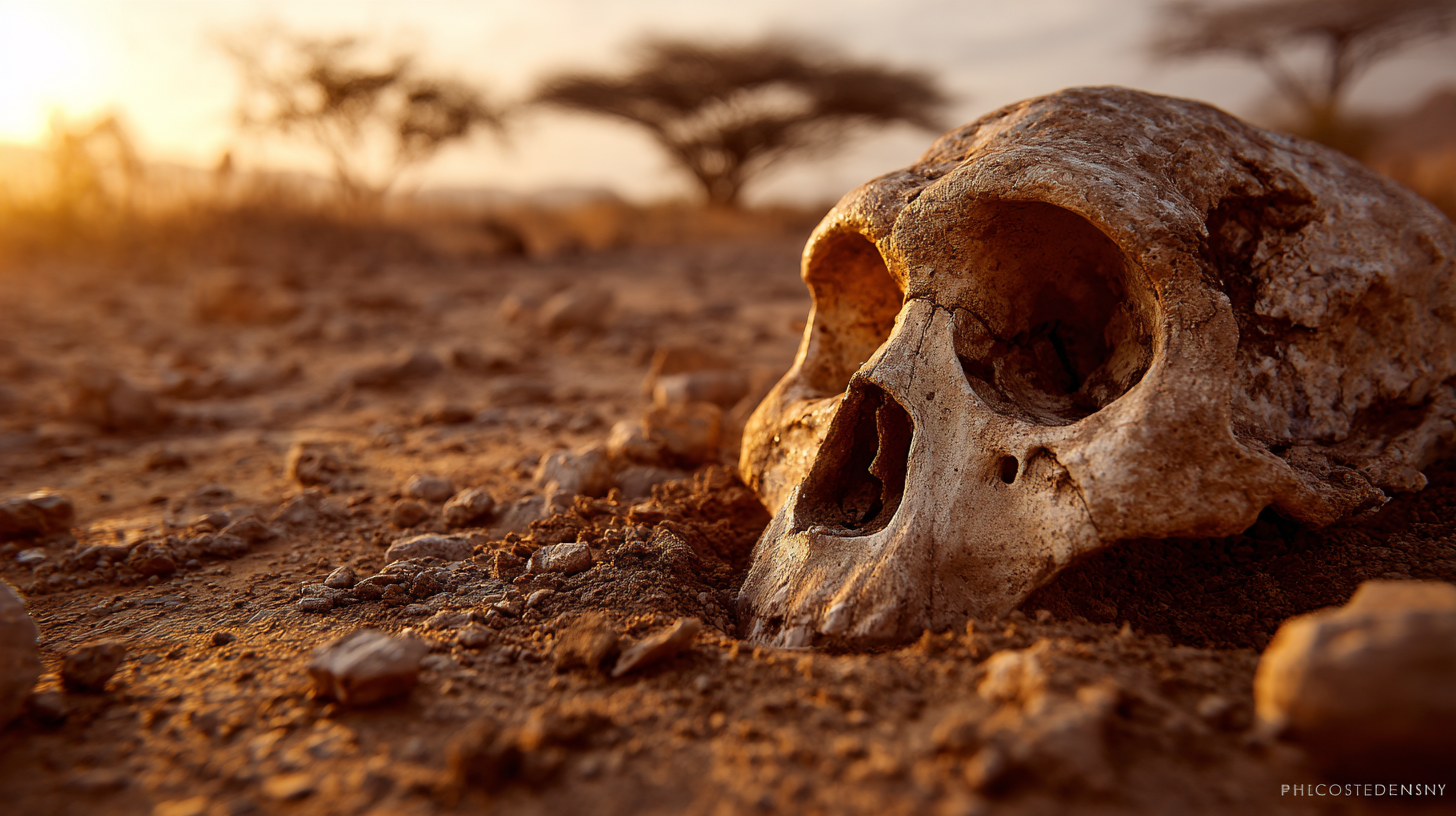
In 2001, a fossil discovery that shocked the world was announced from the Tugen Hills in Kenya. The research team, led by Brigitte Senut and Martin Pickford, named this fossil ‘Orrorin.’ In the local Tugen language, this means “Original Man.”
This discovery was shocking primarily because of its age.
- Discovery Site: Lukeino Formation, Kenya
- Estimated Age: Approximately 6.0 Ma ~ 5.8 Ma (Late Miocene)
This era corresponds to the time right after humans and chimpanzees diverged, based on genetic analysis. In other words, Orrorin is a fossil that witnessed the very first moments when we said goodbye to apes and stepped onto the “path of humanity.”
2. 🦴 The Truth Told by Bones: “I Walked on Two Feet”
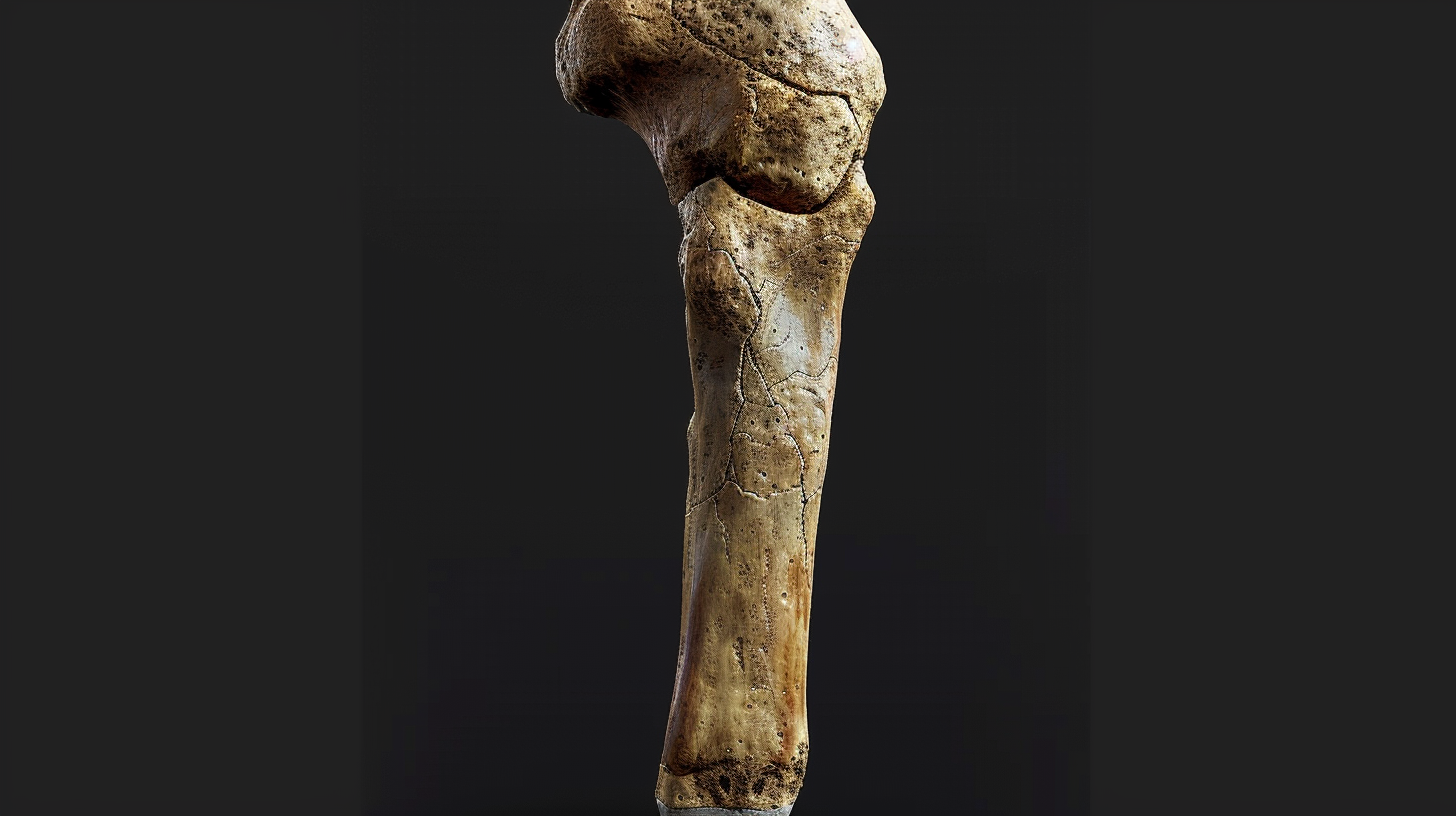
The decisive evidence that Orrorin was an ‘ancestor of humanity’ and not just a simple ape lies in the thigh bone, or Femur (Specimen BAR 1002’00).
Scholars have engaged in fierce debates over this single bone because it hides the secret of bipedalism (upright walking).
🔍 3 Clues That Orrorin Walked
- Long Femoral Neck: The neck of Orrorin‘s femur is longer and flatter than that of modern apes. Structurally, this allows the hip muscles to stabilize the pelvis, making it advantageous for walking on two legs.
- Asymmetric Bone Thickness: CT scans revealed that inside the femoral neck, the bone was thin at the top and thick at the bottom. This is the exact pattern created by weight distribution when walking upright.
- Muscle Trace: There is a specific mark called the ‘Obturator externus groove’ where hip muscles attach. This feature appears when the hip is fully extended (straightened back) during upright walking.
3. ⚔️ The Battle of the Century: Whose Ancestor is Orrorin?
While there is agreement on the fact that they “walked,” a massive debate erupted over “who they resemble.” This is a critical issue that determines whether Orrorin is our direct ancestor or an extinct relative.
🥊 Team A (Discoverers): “Orrorin is a Direct Human Ancestor!”
Discoverers Pickford and Senut argued that Orrorin‘s femur looks more like modern humans (Homo) than Australopithecus (Lucy).
- Claim: “Australopithecus is not an ancestor on the path to humans but a species that branched off and went extinct. Orrorin is the **true ancestor leading directly to the genus Homo **.”
🥊 Team B (US Team): “No, It Resembles Australopithecus!”
Conversely, Professors Richmond and Jungers refuted this through precise morphometric analysis.
- Claim: “Analyzing Orrorin‘s femur shows it is **most similar to Australopithecus or Paranthropus **. Orrorin didn’t walk exactly like humans but likely practiced the unstable bipedalism characteristic of early hominins.”
💡 The Latest Conclusion: A ‘Mosaic’ Existence
The most recent research (Almécija et al., 2013) defines Orrorin as an ‘intermediate stage.’ Orrorin is an evolutionary transitional being that possesses both the features of ancient apes and future humans simultaneously (Mosaic Evolution).
4. 🌳 Walking on Ground, Riding Trees? (A Double Life)
Did Orrorin walk around all day like us? Not at all. The arm and finger bones found with it provide the evidence.
- Curved Fingers: Orrorin‘s finger bones are curved like a chimpanzee’s. This is a structure perfect for gripping tree branches tightly.
- Powerful Arm Muscles: The arm bone (humerus) shows distinct traces where muscles used for climbing (brachioradialis) were attached.
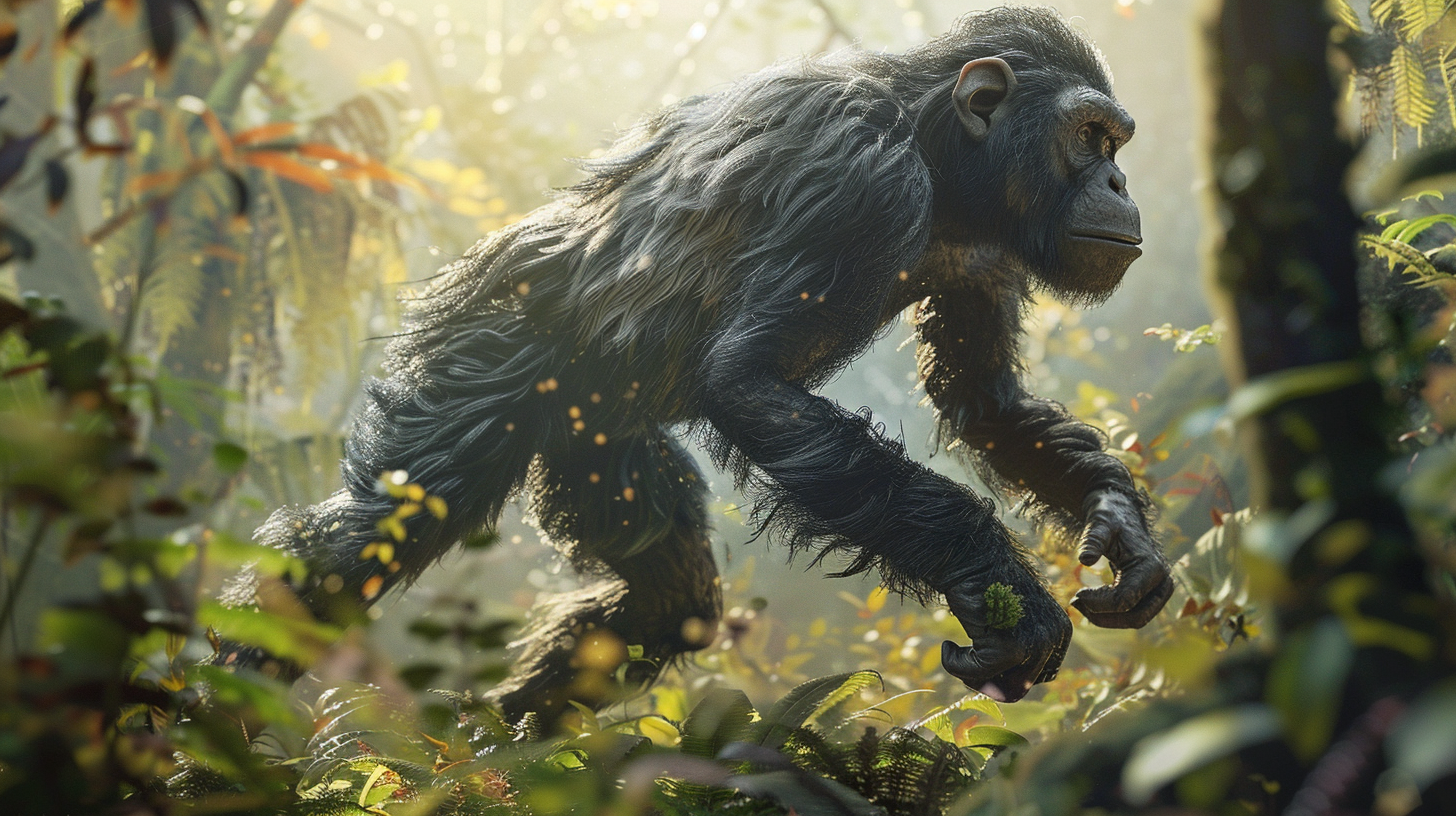
In other words, Orrorin practiced ‘Facultative Bipedalism.’ They walked on two feet on the ground, but when a predator appeared or they needed to sleep, they lived a double life of quickly climbing up trees.
5. 🦷 Diet Seen Through Teeth: Small but Strong
Orrorin‘s teeth solve another mystery of human evolution.
Usually, our cousin Australopithecus had massive molars to chew on tough grass and roots (Megadontia). However, Orrorin was different.
- Small Molars (Microdontia): Orrorin‘s molars are small. This is a feature similar to modern humans.
- Thick Enamel: The teeth are small, but the shell is thick, making them suitable for eating hard fruits or nuts.
- Canine: Although smaller than a chimp’s, it still retains a pointed feature, showing traces of apes.
Researchers use these small teeth as strong evidence for the claim that “humans evolved without passing through Australopithecus.” The logic is that it makes more sense for a lineage to maintain small teeth from the beginning rather than teeth getting huge (Australopithecus) and then small again (Humans).
📝 3-Line Summary: Why is Orrorin Important?
Complex Evolution: Showing a mosaic form where ape and human features are mixed, it proves that human evolution was not a single ladder but evolved like a complex bush branching out in many directions.
Oldest Ancestor Candidate: Orrorin tugenensis lived 6 million years ago in Kenya and is a key fossil showing the appearance immediately after the split between humans and apes.
Definite Bipedalism: Femoral analysis confirms they walked on two feet, but they also possessed excellent tree-climbing abilities.
References
- Pickford, M. (2002). Bipedalism in Orrorin tugenensis revealed by its femora. Comptes Rendus Palevol, 1(4), 191–203.
- Pickford, M. (2001). First hominid from the Miocene (Lukeino Formation, Kenya). Comptes Rendus de l’Académie des Sciences – Series IIA – Earth and Planetary Sciences, 332(3), 137–144.
- Richmond, B. G. (2008). Orrorin tugenensis femoral morphology and the evolution of hominin bipedalism. Science, 319(5870), 1662–1665.
- Sawada, Y. (2002). The age of Orrorin tugenensis, an early hominid from the Tugen Hills, Kenya. Comptes Rendus Palevol, 1(5), 293–303.
- Senut, B. (2005). Orrorin tugenensis upper limb: description and implications for the origin of hominin locomotion. Comptes Rendus Palevol, 4(4), 305–311.
- Senut, B. (2018). Dental anatomy of the early hominid, Orrorin tugenensis, from the Lukeino Formation, Tugen Hills, Kenya. Revue de Paléobiologie, 37(2), 577–591.
- Almécija, S. (2013). The femur of Orrorin tugenensis exhibits morphometric affinities with both Miocene apes and later hominins. Nature Communications, 4(1), 2888.
- Harcourt-Smith, W. H. E. (2010). The first hominins and the origins of bipedalism. Evolution: Education and Outreach, 3(3), 333–340.
- Wood, B. (2011). The evolutionary context of the first hominins. Nature, 470(7334), 347–352.