
We are commonly taught that humanity settled down and built civilizations after agriculture began. However, recent discoveries in archaeology suggest that this order might be wrong. There were people who formed villages, baked bread, raised dogs, and enjoyed fashion long before they ever farmed.
This is the story of the Natufian Culture, the key that opened the dawn of civilization.
1. Who Were They? Descendants of the Mysterious ‘Basal Eurasians’
The Natufian people appeared around 13,000 BC in the ‘Levant’ region, which spans modern-day Israel, Jordan, and Syria. According to recent ancient DNA analysis, they possessed a unique lineage known as ‘Basal Eurasian’.
Interestingly, they were a genetically isolated group, distinct from contemporary populations in surrounding areas like Turkey (Anatolia) or Iran (Zagros Mountains). This implies that agriculture was not spread by a single ethnic group, but was the result of people with different backgrounds struggling to survive in their respective regions.
2. Leaving Caves to Build Villages (The First Settlement)
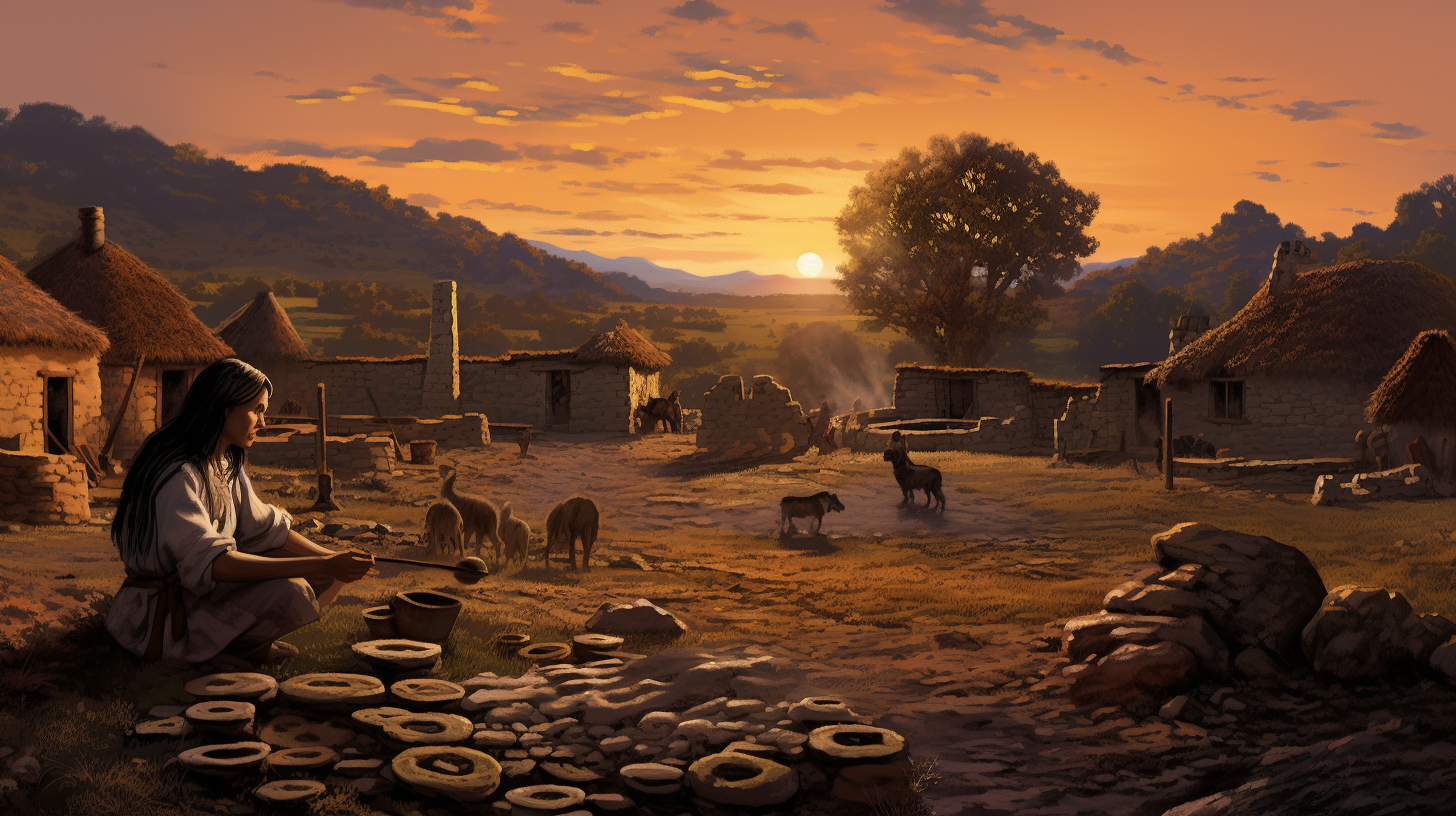
The Natufians were the first humans in history to stop wandering and live in one place (Sedentism). They built semi-subterranean circular houses (Pit-houses) with stone foundations and formed villages.
These were not simple huts. Some structures were massive, reaching 9 meters in diameter, and were equipped with sophisticated hearths, workspaces, and even paved stone floors. This demonstrates that they were not merely places to sleep, but formed a ‘community’ where complex social activities took place.
3. Icons of Innovation: Stone Knives Assembled Like ‘Lego’
The Natufians were geniuses of toolmaking. Their signature item was the ‘Lunate’ (crescent-shaped stone tool).
The core of their innovation lay in mass-producing tiny, finger-sized crescent blades called ‘microliths’. They inserted these small blades in a row into long handles made of bone or wood, much like assembling Lego blocks. The sickles created this way were incredibly efficient for harvesting wild cereals. If a blade became dull, they didn’t need to throw away the whole tool; they simply swapped out the dull stone fragment for a new one.
4. The Beginning of Gastronomy: Bread Before Farming?
In 2018, a discovery turned the archaeological world upside down. At the Shubayqa 1 site in Jordan, bread crumbs dating back 14,400 years were found.
This predates the full-scale onset of agriculture by a staggering 4,000 years. They ground wild wheat (Einkorn) and club-rush tubers into flour, made dough, and baked it on hot stones. This became definitive evidence supporting the hypothesis that “people didn’t start farming because they were hungry, but potentially because they wanted to eat delicious bread (gastronomy)”.
5. Global Fashion 14,000 Years Ago: Shell Necklaces from the Red Sea
The Natufians were fashion leaders who knew how to style themselves. Countless ornaments have poured out of their sites, with ‘Dentalium’ (tusk shells) being overwhelmingly common.
What is surprising is that these shells were brought from the Mediterranean or the Red Sea, very far from where they lived. Shells from the Nile Valley have even been found. This indicates that a long-distance trade network spanning hundreds of kilometers already existed at that time. They used these shells to make elaborate headgear, necklaces, bracelets, and belts to adorn themselves and display their status.
6. Soulmates: Dogs Become Family
The Natufians were the first humans to domesticate dogs. At the Ein Mallaha site in Israel, a grave was found containing an elderly person buried with a 3-to-5-month-old puppy.
The image of the elderly person’s left hand cradling the puppy’s neck eloquently testifies that the dog was not merely livestock or food, but a companion sharing an emotional bond. Dental analysis revealed that this dog had a smaller jaw than a wolf, indicating that domestication was already underway. Long before sheep or cattle, dogs were already our friends.
7. Mysterious Rituals: The Shaman’s Grave
In the Hilazon Tachtit cave in Israel, a grave was discovered that reveals the complex spiritual world of the Natufians: the ‘Shaman’.
The owner of the grave was a 45-year-old woman who was about 1.5 meters tall and had a physical disability. Her body was surrounded by an unimaginable array of grave goods: 50 tortoise shells, an eagle’s wing, the leg of a wild boar, a leopard’s pelvis, a cow’s tail, and so on. These animals likely symbolized spiritual powers. The massive funeral rite involving the capture and offering of 50 tortoises suggests she was a figure of immense social importance.
8. The Climate Crisis and a Crossroads of Destiny: Farming vs. Wandering?
A crisis struck the prospering Natufian society. Around 11,000 BC, the ‘Younger Dryas’, a sudden period of cold and dry glacial conditions, arrived. As the abundant wild cereals dwindled, the Natufians stood at a crossroads.
- Choice 1: Leave Again (Harifian Culture) People living in arid regions like the Negev Desert abandoned their settled lives and returned to a mobile lifestyle. They developed sophisticated arrowheads called ‘Harif points’ to focus on hunting, but eventually, unable to withstand the environmental deterioration, they disappeared from the region.
- Choice 2: Cultivate the Land (PPNA, The Beginning of Agriculture) On the other hand, those who remained in water-rich areas like the Jordan Valley chose ‘artificial cultivation’ instead of moving. To obtain more food from a shrunken territory, they began to plant and tend wild cereals. This desperate adaptation resulted in the start of agriculture, which changed human history forever.
Epilogue
The Natufian culture was not merely a simple stepping stone between the Paleolithic and the Neolithic. They were great pioneers who dared the adventure of settled life in the face of the massive challenge of climate change, created the gastronomy of bread, and blossomed in art and religion.
The way of life we enjoy today—eating bread in comfortable homes with our pet dogs—is a great legacy left to us by the Natufian people 14,000 years ago.
References
- Arranz-Otaegui, A., et al. (2018). Archaeobotanical evidence reveals the origins of bread 14,400 years ago in northeastern Jordan. PNAS.
- Bar-Yosef, O. (1998). The Natufian Culture in the Levant, Threshold to the Origins of Agriculture. Evolutionary Anthropology.
- Belfer-Cohen, A. (1991). The Natufian in the Levant. Annual Review of Anthropology.
- Boyd, B., & Cook, J. (1993). A Reconsideration of the ‘Ain Sakhri’ Figurine. Proceedings of the Prehistoric Society.
- Davis, S. J. M., & Valla, F. R. (1978). Evidence for domestication of the dog 12,000 years ago in the Natufian of Israel. Nature.
- Grosman, L., et al. (2008). A 12,000-year-old Shaman burial from the southern Levant (Israel). PNAS.
- Grosman, L., & Munro, N. D. (2016). The Natufian Culture: A New Approach to the Transition to Agriculture. The Cambridge World History.
- Lazaridis, I., et al. (2016). Genomic insights into the origin of farming in the ancient Near East. Nature.