
In 1972, when an excavator operator accidentally discovered gold artifacts at a construction site in Varna, Bulgaria, no one knew that this would rewrite human history. Long before the Egyptian pyramids were built, around 4600 BC, a brilliant “Golden Civilization” already existed on the Black Sea coast.
Today, we delve into everything about the Varna Necropolis. Let’s step into a time capsule containing power, technology, and the mysteries of ancient humanity.
1. Reconstruction of Time: A Short, Intense Golden Age
The Varna Necropolis was long thought to have developed gradually over the latter half of the 5th millennium BC. However, modern science reveals that this civilization grew explosively like a “supernova” in a short period and then vanished.
- Precision Dating: Initially, there was confusion in dating due to the “Marine Reservoir Effect” caused by the consumption of marine life. Correcting for this, recent studies estimate that the cemetery was used intensively for a relatively short period of about 120 to 260 years, between 4590 BC and 4340 BC.
- Explosive Growth: In this short time, Varna rose from a simple burial ground to a massive “Social Arena” encompassing the entire Black Sea coast.
2. The Mystery of Grave 43: Was He a King or a Divine Blacksmith?
The highlight of the Varna Necropolis is undoubtedly “Grave 43.” The deceased, estimated to be a male in his 40s or 50s, held a gold-decorated stone axe (sceptre) in his right hand, and his body was covered with 1.5 kg of gold. Scholars have traditionally regarded him as the first “Priest-King” or a powerful paramount chief. However, a shocking reversal hypothesis has recently been proposed.
🔍 “It’s Not a Penis Sheath?” (The Penis Sheath Controversy)
In museums, a gold artifact is often reconstructed and displayed as a “Gold Penis Sheath” placed over the deceased’s groin (Fig. 11, 12). It has been interpreted as a symbol of male authority and power.
However, a precise re-examination of excavation records revealed that the original position of this artifact was not at the waist. Recent research suggests the possibility that this gold tube was actually a decoration for the nozzle of a “tuyère” (a blowpipe used to supply air to a furnace) used when melting metal. If this is true, he may not have been a simple ruler, but a “Smith-King” who possessed the sacred knowledge of handling metal.
3. The Obsession of Ancient Artisans: Mastering Color
The gold of Varna is astonishing not just for its quantity. They possessed high-tech skills to control the “color” of metal as early as 6,500 years ago.
- First Alloying Experiments: Varna artisans didn’t just use natural gold. They intentionally distinguished between “silvery gold” (high silver content) and reddish gold mixed with copper .
- The Magic of Color (Polychromy): The necklace found in Grave 43 features yellow gold beads and pale gold beads arranged alternately to create a visual color contrast. This represents one of the earliest attempts at alloying and color control in human history.
- Mass Production System: The discovery of thousands of gold beads with uniform size and weight indicates that a professional “Serial Production” system was already in operation at that time.
4. Graves Without Faces: Cenotaphs and Golden Masks
The Varna Necropolis contains graves without bodies, known as Cenotaphs (Symbolic Graves). Graves 2, 3, and 15 are particularly bizarre and mysterious.
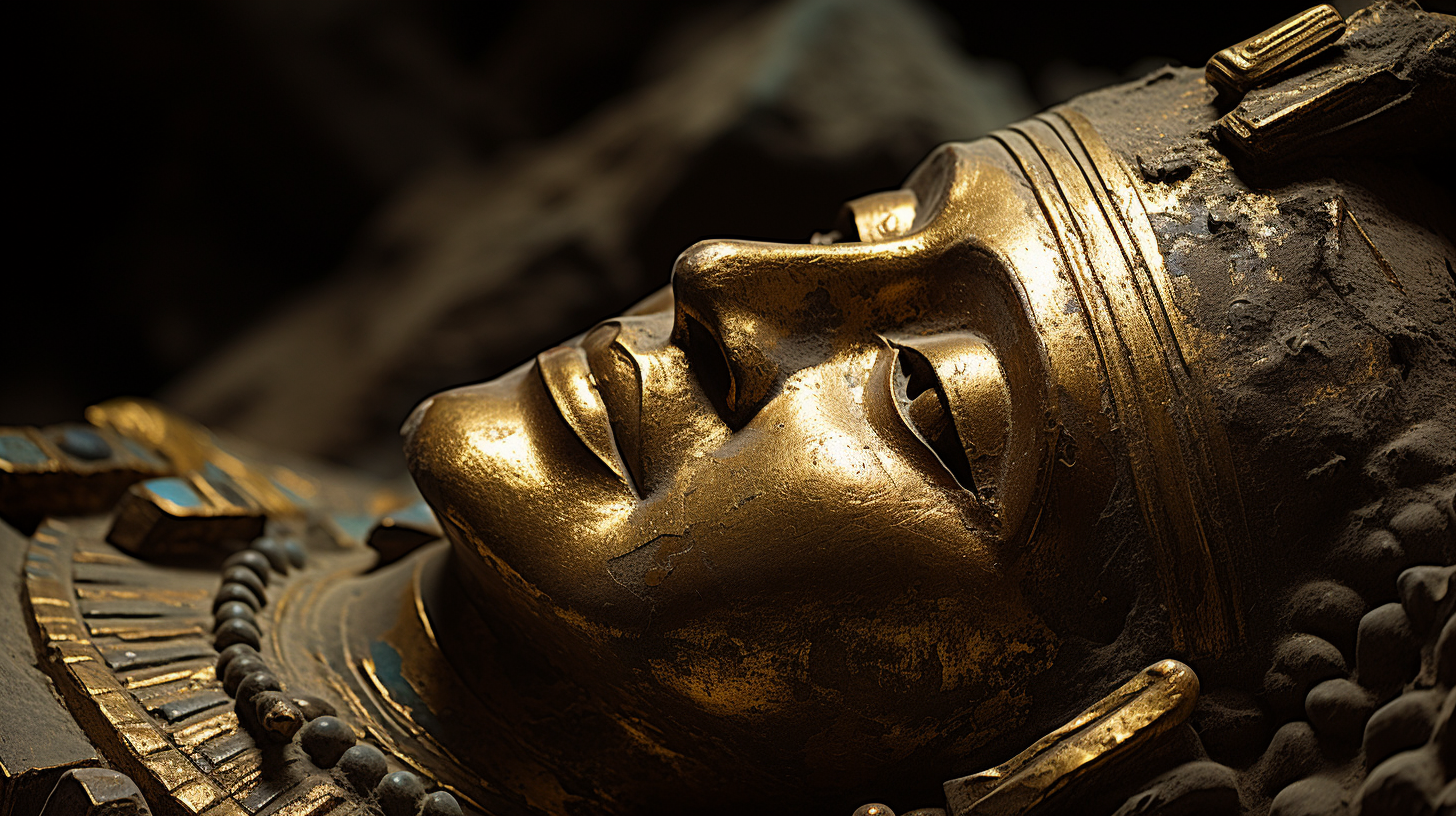
- The Secret of the Clay Mask: Where the body should be, a life-sized Clay Mask was laid. Golden decorations were attached to the eyes, mouth, and ears of this mask, and a gold crown (Diadem) was placed on its head.
- Who Was It For?: Scholars speculate that these were ritual spaces to honor a powerful figure whose body could not be recovered from a battlefield, or perhaps to worship a God in human form. It reveals their intense desire to adorn even death with gold forever.
5. Sudden Collapse: Was it the Curse of Gold?
Why did such a brilliant civilization suddenly disappear from history around 4300 BC?
Scholars point to “excessive Social Tension” as the cause. The extreme concentration of wealth, as seen in Grave 43, and competitive conspicuous consumption deepened internal social inequality. This competitive class structure likely weakened the social cohesion needed to withstand crises like external shocks or climate change, leading to the collapse of the entire system.
6. Conclusion: A Cemetery Turned History
The Varna Necropolis is not just a communal graveyard. It is a melting pot of desire and technology where prehistoric humanity first began to express “Private Property” and “Rank” through the material of gold.
Whether the protagonist of Grave 43 was a great king or a divine blacksmith, the legacy he left behind testifies to us today of both the splendor of civilization and the precariousness that lies beneath it.
References:
- Higham, T., et al. (2018). AMS Dating of the Late Copper Age Varna Cemetery, Bulgaria. Radiocarbon.
- Krauß, R., et al. (2017). Chronology and development of the Chalcolithic necropolis of Varna I. Documenta Praehistorica.
- Leusch, V., et al. (2014). Chalcolithic gold from Varna – Provenance, circulation, processing, and function.
- Renfrew, C. (1978). Varna and the social context of early metallurgy. Antiquity.
- Chapman, J. (1991). The creation of social arenas in the Neolithic and Copper Age of S.E. Europe.
- Higham, T., et al. (2007). New perspectives on the Varna cemetery (Bulgaria). Antiquity.