
Do you know the oldest epic in human history, the ‘Epic of Gilgamesh’? It is set in the city where the legendary hero Gilgamesh ruled as king: Uruk.
While many know Gilgamesh, few know what the era he lived in was actually like. Archaeologists call the period between 4000 BC and 3100 BC the ‘Uruk Period’. This wasn’t just “ancient times.” It was the starting point of a surprisingly modern system where humanity first began living in ‘cities’, invented ‘writing’, and worked in exchange for ‘beer’ rations.
Today, based on 14 recent research papers, we uncover the true face of Uruk, where myth and history intersect.
1. A Miracle Built on Mud: Humanity’s First Megacity
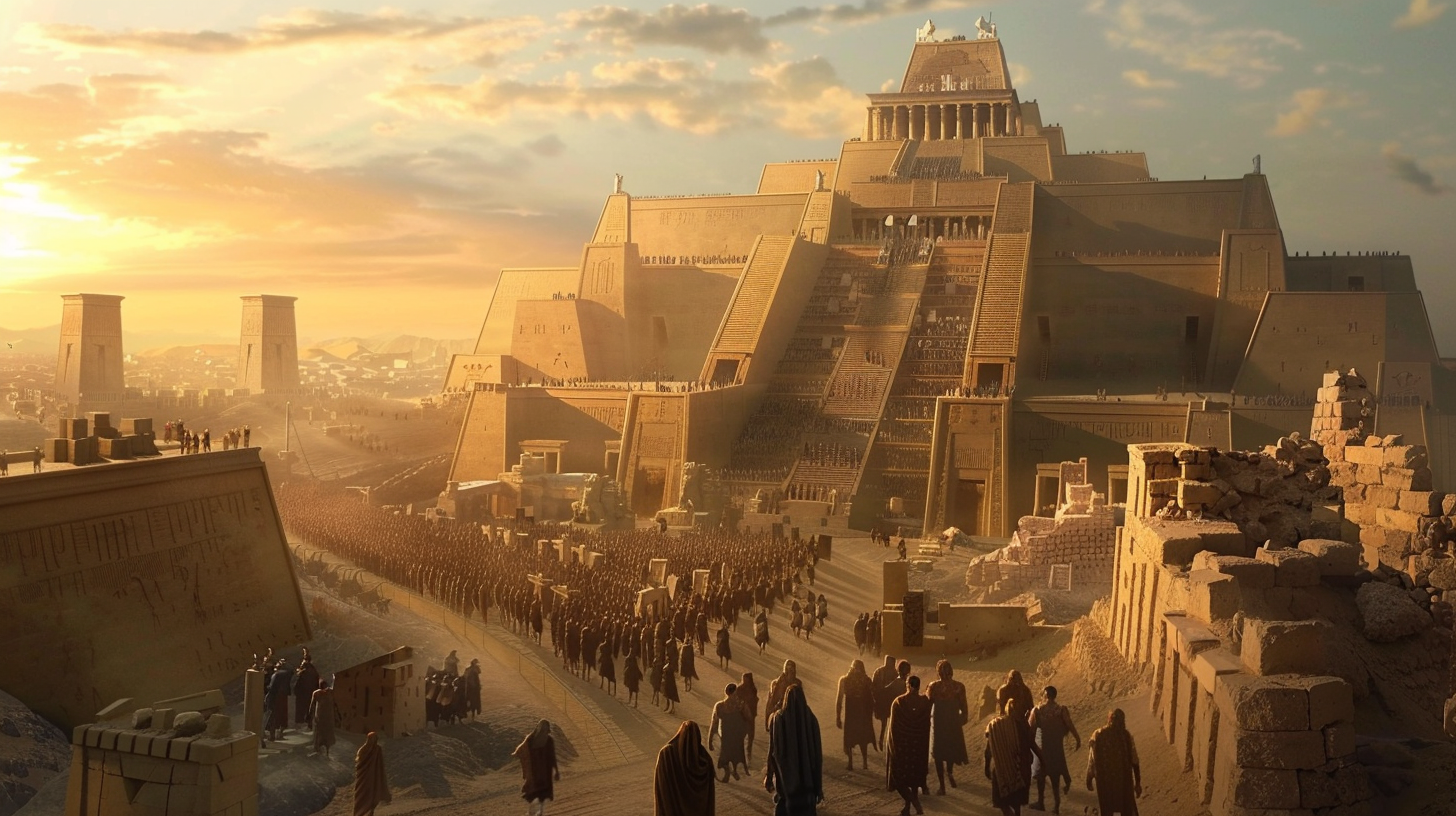
Around 4000 BC, a massive change occurred in the alluvial plains of southern Mesopotamia (modern-day southern Iraq). Small villages merged to birth a colossal city named Uruk (Warka). At its peak, Uruk covered an area of about 2.5–4 km² (approx. 600–1,000 acres) and was home to tens of thousands of people. By the standards of the time, this was an unimaginable ‘megacity.’
🏛 A City of Splendid ‘Cone Mosaics’
Uruk was not a drab city of mud. Its temples were decorated with a unique technique called ‘Cone Mosaics’.
Archaeologists have discovered tens of thousands of clay cones. The people of Uruk painted the heads of these cones red, black, and white, and then embedded them tightly into mud walls to create dazzling geometric patterns. This is one of the first examples of public architectural decoration in human history, demonstrating just how prosperous Uruk was.
2. The City of Gods: Anu and Inanna
At the center of the city lay two massive temple districts.
- The Anu Ziggurat: Dedicated to the sky god ‘Anu,’ located at the highest point of the city.
- The Eanna District: Dedicated to the goddess of love and war, ‘Inanna’.
The Eanna District, in particular, was not merely a religious facility. It was the ‘White House’ and the ‘IRS’ that oversaw the city’s administration and economy. Numerous administrative ledgers and storehouses were found here, proving that religious power at the time held the reins of the economy.
🏺 The Birth of Class: The Warka Vase
The artifact that most dramatically illustrates the social aspect of this period is the ‘Warka Vase’. This massive stone vessel is carved with the worldview of the time in layers.
- Bottom: Water and plants (The foundation of production)
- Middle-lower: Herds of sheep and goats (Agricultural products)
- Middle-upper: Nude men carrying baskets (Laborers/Commoners)
- Top: The Priest-King offering tribute to the goddess Inanna
This sculpture proves that Uruk was a strict class society and reveals a structure where all produce belonged to the god (in reality, the temple).
3. The Ancient Worker’s Bowl and ‘Beer’
The brilliant civilization of Uruk was built upon the sweat of countless laborers. The most common and abundant artifact found at archaeological sites is a crude vessel known as the ‘Beveled Rim Bowl’.
🍺 “Pay Me in Beer”
What is the identity of this ugly bowl? Scholars are convinced that this was a ‘disposable lunch box’ or a ‘standard measuring cup’ used to distribute grain rations to workers.
While the bowls often contained barley, it is highly likely they also held ‘beer’. At the time, beer (Sikaru) was less of a liquor and more of a ‘drinkable bread,’ an essential source of calories. The sight of thousands of workers lining up to receive their daily ration in these bowls—this was the daily life of Uruk 5,000 years ago.
4. Innovation: ‘Writing’ Born from Bookkeeping
As the city grew and the economy became complex, human memory was no longer sufficient to track who paid taxes and who received rations. Thus, humanity’s greatest invention, writing, was born.
🔢 From Tokens to Tablets
Writing did not appear overnight.
- Tokens: Initially, small clay models shaped like objects (sheep, jars of barley, etc.) were used to count quantities.
- Bulla: To secure transactions, these tokens were sealed inside round clay balls called bullae.
- Clay Tablets: To check the contents without breaking the bulla, they pressed the tokens onto the surface to leave a mark. People soon realized: “Instead of putting tokens inside, why not just press marks onto a wet clay slab?”
These ‘marks’ evolved into the Cuneiform script we know today. In other words, the first writing was invented not to write poetry or history, but for ‘Bookkeeping’.
5. The First Globalization: The Uruk Expansion
Uruk lacked resources. It had fertile land, but no wood, stone, or metal to build temples. So, they turned their eyes outward.
Uruk merchants ventured as far as Susa in Iran, Habuba Kabira in Syria, and Hacinebi in Turkey. In some places, they built colonial cities identical to Uruk; in others, they established merchant enclaves within corners of local villages to live and trade.
This was the first ‘World System’ in human history. Uruk’s pottery, architectural techniques, and administrative systems spread across the Middle East.
6. Conclusion: The Legacy of Gilgamesh
Around 3100 BC, Uruk’s vast network suddenly collapsed. However, the legacy they left behind did not disappear. The way of life known as the ‘City’, the governance system known as the ‘State’, and the information technology known as ‘Writing’ invented by Uruk were inherited by the later Sumerian civilization and continue to influence us today.
The scenery Gilgamesh gazed upon as he walked the city walls in the legend was the very dawn of the massive civilization that humanity had created for the first time.
References
- Adams, R. McC. (1981). Heartland of Cities. University of Chicago Press.
- Algaze, G. (1993). The Uruk World System: The Dynamics of Expansion of Early Mesopotamian Civilization. University of Chicago Press.
- Algaze, G. (2013). “The End of Prehistory and the Uruk Period.” In The Sumerian World. Routledge.
- Liverani, M. (2006). Uruk: The First City. Equinox.
- Millard, A.R. (1988). “The Bevelled-Rim Bowls: Their Purpose and Significance.” Iraq, 50.
- Nissen, H.J. (1988). The Early History of the Ancient Near East. University of Chicago Press.
- Nissen, H.J., Damerow, P., & Englund, R.K. (1993). Archaic Bookkeeping. University of Chicago Press.
- Rothman, M.S. (Ed.). (2001). Uruk Mesopotamia & Its Neighbors. SAR Press.
- Schmandt-Besserat, D. (1992). Before Writing. University of Texas Press.
- Schmandt-Besserat, D. (1997). How Writing Came About. University of Texas Press.
- Stein, G.J. (1999). Rethinking World-Systems: Diasporas, Colonies, and Interaction in Uruk Mesopotamia. University of Arizona Press.