

Enuma Elish, the quintessence of Ancient Near Eastern mythology and often called the ‘Babylonian Genesis,’ is not merely an ancient tale. Hidden within it are the ancient worldview, intense political propaganda, and intriguing connections to the Bible.
Today, we delve into everything about Enuma Elish—from the discovery of the tablets that shocked 19th-century Europe to the sophisticated political codes concealed within the myth.
1. The ‘Babylonian Genesis’ Buried in the Sand
The story begins in London in 1872. George Smith of the British Museum made a startling discovery while deciphering broken clay tablets excavated from the ruins of ancient Nineveh. The content he deciphered was shockingly similar to the biblical book of Genesis.
In 1876, Smith published this discovery in a book titled The Chaldean Account of Genesis. People were shocked by the fact that “a similar creation story already existed before the Bible”. Thus, Enuma Elish re-emerged into the world.
2. The Plot: Tearing Through Chaos to Establish Order
The title ‘Enuma Elish’ is derived from its opening phrase, “When on high”.
The Primordial War and the Rise of Marduk
In the beginning, there were Apsû (fresh water) and Tiamat (sea). When Apsû tried to kill his children due to their noise, the god of wisdom, Ea, killed Apsû first and established his dwelling upon him. Enraged, Tiamat birthed 11 monsters for revenge and granted Qingu, a god, the ‘Tablet of Destinies’—a symbol of supreme power—preparing for war.
The Decisive Scene: Yielding the Tablet of Destinies
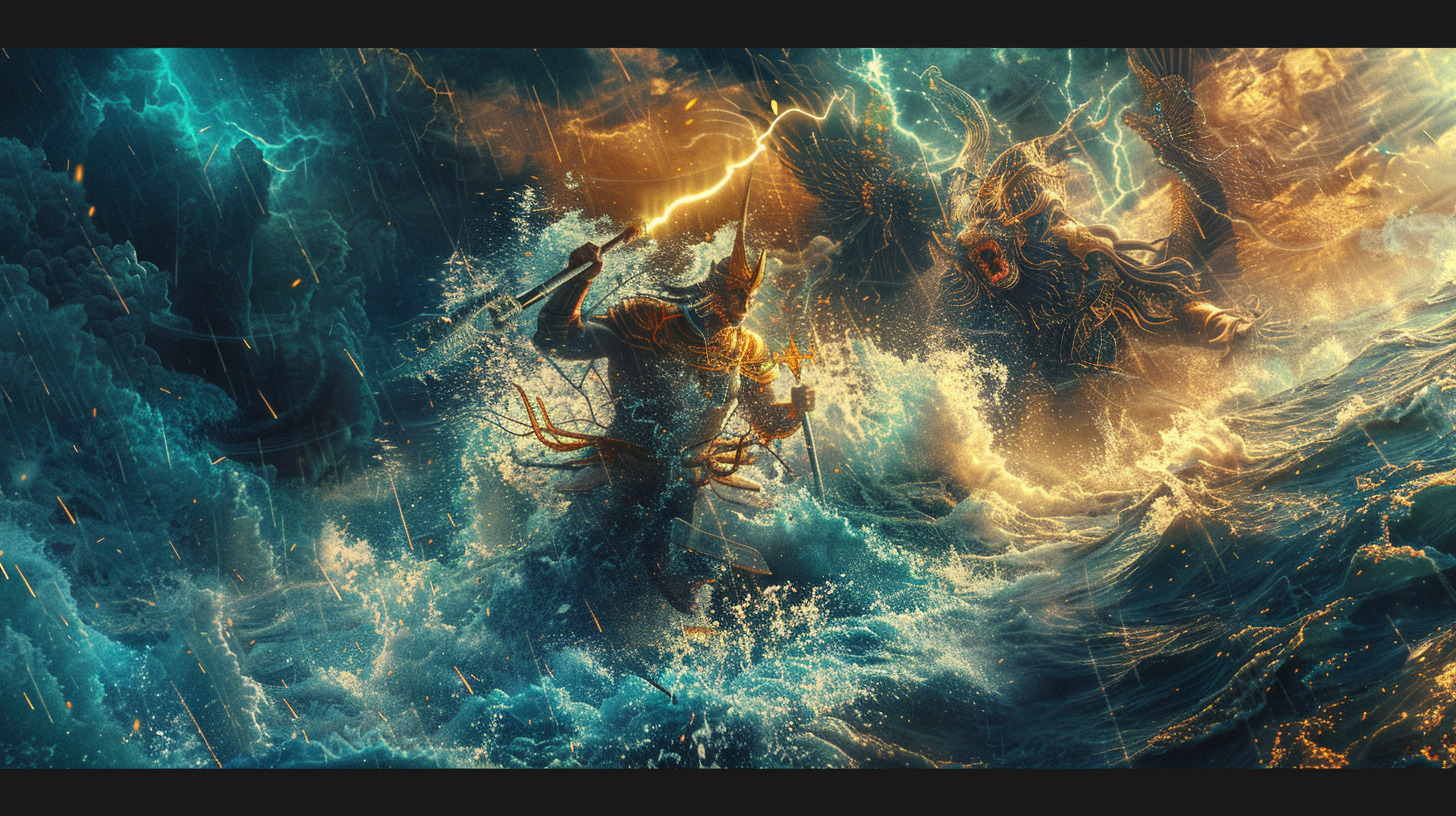
The gods trembled in fear, seeking a savior, and Ea’s son, Marduk, stepped forward as champion. Marduk subdued Tiamat using storms and winds as weapons and killed her.
Here, a crucial scene unfolds. Marduk subdues Qingu and seizes the ‘Tablet of Destinies’. However, instead of monopolizing this symbol of absolute power, he presents it as a gift to his grandfather, Anu, the god of the sky. This was a sophisticated political gesture declaring that Marduk was not a ‘usurper’ who stole power, but a ‘legitimate successor’ inheriting the authority of the ancient gods.
3. Behind the Myth: A Duet of Nature and Politics
What meaning lies behind this grand epic?
Interpretation 1: War of Storm and Sea (Nature Myth)
Thorkild Jacobsen interprets this battle as a clash of natural phenomena. The name Marduk (Mar-utu-k) implies ‘Son of the Storm’ , and the weapons he uses (winds, floods) prove he was originally a storm god. In other words, this myth depicts the providence of nature where the storm (order) calms the rough sea (chaos).
Interpretation 2: Political Propaganda for Babylon (Political Myth)
Andrea Seri and Piotr Michalowski analyze this myth as propaganda to justify Babylon’s hegemony. The scene where Marduk builds Babylon’s temple, Esagila, mimicking Ea’s dwelling (Apsû) and Enlil’s dwelling (Ešarra) , is a declaration that the center of the universe has now shifted to Babylon.
4. The Historical Scene: The Akitu Festival and Recitation
Enuma Elish was not a book sitting in a library. This myth came alive before people’s eyes during the Akitu Festival (New Year’s Festival), Babylon’s greatest holiday.
On the evening of the 4th day of the month of Nisannu, the high priest solemnly recited the entire Enuma Elish before the statue of Marduk. Through this ritual, the Babylonians believed they were reenacting the primordial victory in the ‘here and now’ and renewing the king’s power and cosmic order. In short, the myth was the script for a massive religious performance sustaining the state.
5. The Unfinished Debate: Relationship with the Bible
The relationship between Enuma Elish and the Bible (Genesis Chapter 1) remains a hot topic.
- Striking Similarities: The sequence and motifs, such as primordial water, the creation of light, and the creation of humans, are very similar.
- The Truth of Language: In the past, scholars thought the biblical ‘Tehom’ (the deep) was a copy of ‘Tiamat’. However, according to David Tsumura’s research, the two words are not directly related but are merely ‘sibling words’ sharing the same etymological root.
In conclusion, the Bible did not simply plagiarize the Babylonian myth. Rather, on the same cultural soil, it offered a completely different theological answer to the question: “Is the world a bloody battlefield of gods (Babylon), or the peaceful creation of the One God (Bible)?”
In Conclusion
Enuma Elish is the story of Marduk tearing through chaos to establish order, and a record of the Babylonian Empire’s powerful desire to become the center of the world. The secrets of the universe and power dreamed of by the ancients lie within these clay tablets.
References
- Heidel, A. (1951). The Babylonian Genesis (2nd ed.). University of Chicago Press.
- Jacobsen, T. (1968). The battle between Marduk and Tiamat. Journal of the American Oriental Society, 88(1), 104–108.
- King, L. W. (1902). The seven tablets of creation. Luzac and Co.
- Michalowski, P. (1990). Presence at the creation. In The origins of state societies in the Near East (pp. 381–396). Undena Publications.
- Seri, A. (2012). The role of creation in Enūma eliš. Journal of Ancient Near Eastern Religions, 12(1), 4–29.
- Tsumura, D. T. (1994). Genesis and ancient Near Eastern stories of creation and flood: An introduction. In I will open my mouth in parables (pp. 27–57). Sheffield Academic Press.