
Where did we come from? To answer this age-old question, scientists scour dust-blown deserts and dedicate decades to analyzing a single, tiny bone fragment.
Today, I’d like to introduce the protagonist who graces the very first page of human evolutionary history—and remains one of its most mysterious figures: Sahelanthropus tchadensis. But rather than that tongue-twisting scientific name, why don’t we call him by his beautiful nickname, ‘Toumaï’?
1. ‘Hope of Life’ Blooming in the Desert
‘Toumaï’ means “Hope of Life” in the Goran language of Chad. It is a name given to children born just before the dry season in the harsh desert, embodying a desperate prayer for their survival.
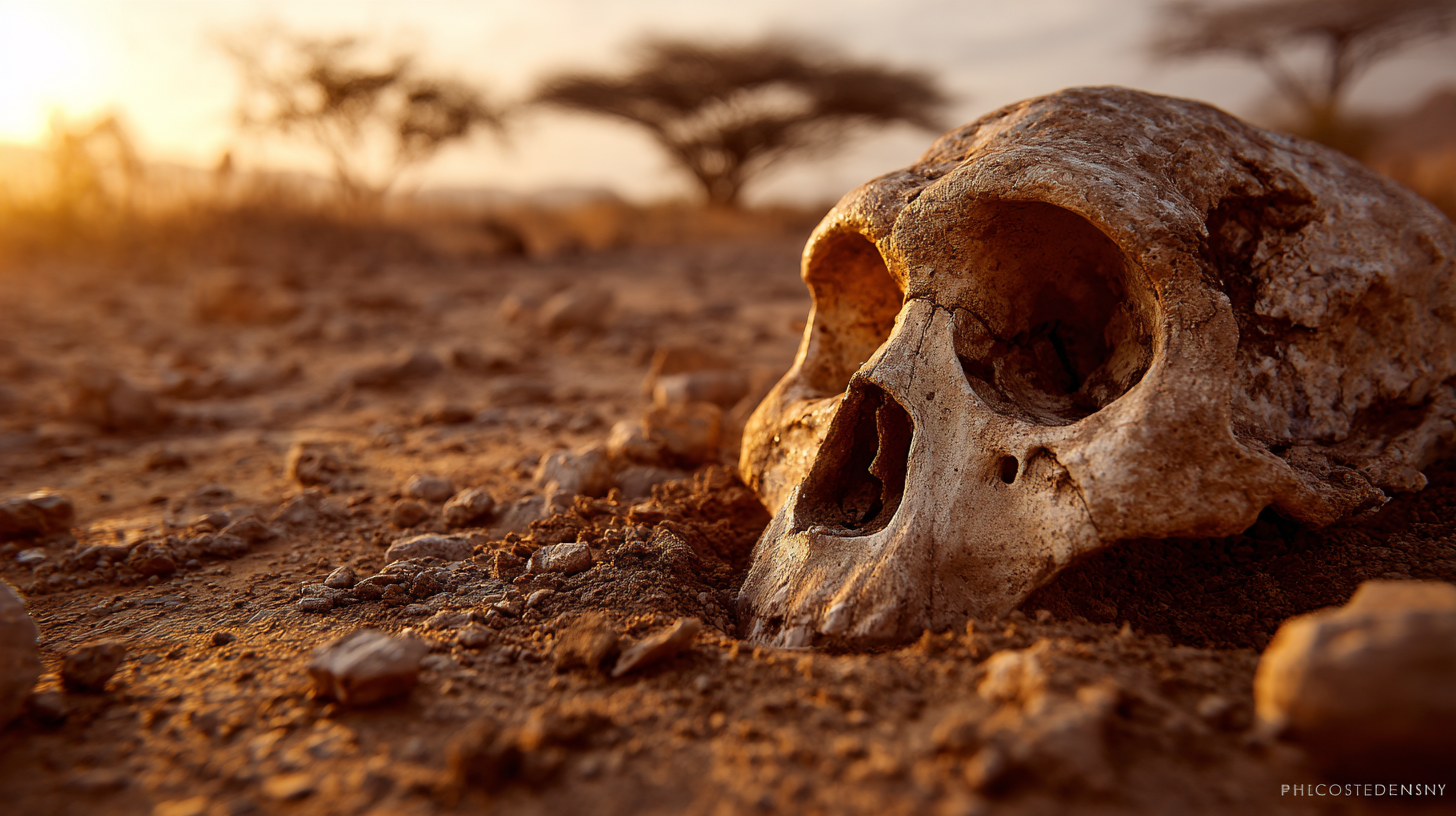
In 2001, an exploration team led by Professor Michel Brunet discovered a skull in the fierce sandstorms of the Djurab Desert in north-central Africa. Seven million years ago, however, this place was not a barren desert but a lush land where lakes, forests, and grasslands coexisted.
This discovery shocked the global paleoanthropology community. Why?
- A Geographical Twist: Until then, it was believed that humanity originated solely to the east of the East African Rift Valley (the “East Side Story”). However, Toumaï was found 2,500 km west of that valley. It was proof that the cradle of humanity was much wider than previously thought.
- A Chronological Shock: Toumaï lived approximately 7 million years ago (7.04 Ma). This is more than double the age of the famous ‘Lucy’ (Australopithecus). It represents that “decisive moment” when the human and chimpanzee lineages had just split.
2. Different from Chimps! Decisive Evidence Toumaï is ‘Human’
Toumaï’s brain size is only about 360–370 cc, similar to that of a chimpanzee. On the surface, he looks just like an ape. However, inside the skull, scientists found two crucial pieces of evidence indicating he had bid farewell to chimps and stepped onto the path of ‘Humanity’ (Hominins).
① Canines: Choosing Peace Over Weapons
The canines of male chimpanzees are sharp weapons. When they close their mouths, the upper canine sharpens against the lower teeth (honing complex). However, Toumaï’s canines were small, and the tips were worn down bluntly. This implies that Toumaï no longer used his teeth as tools for fighting. This shift—reducing aggression and enhancing chewing function—is the very first signal of human evolution.
② Foramen Magnum: A Head Perched Like a Lollipop
At the base of the skull, there is a large hole where the spinal cord enters, called the ‘Foramen Magnum’.
- Chimpanzees (Quadrupedal): The hole is located at the back. Their heads hang forward from their bodies.
- Humans (Bipedal): The hole has moved to the center-forward position. The head balances vertically on top of the spine, much like a lollipop on a stick.
Virtual reconstruction via CT scanning revealed that Toumaï’s foramen magnum was positioned significantly further forward than that of a chimpanzee. This strongly suggests that Toumaï held his head high and practiced upright bipedal walking on the ground.
3. The Hot Debate: “Did He Really Walk Perfectly?”
While the cranial evidence for walking was strong, the academic community has been locked in a fierce debate for over 20 years regarding the definitive interpretation of the ‘leg bone’.
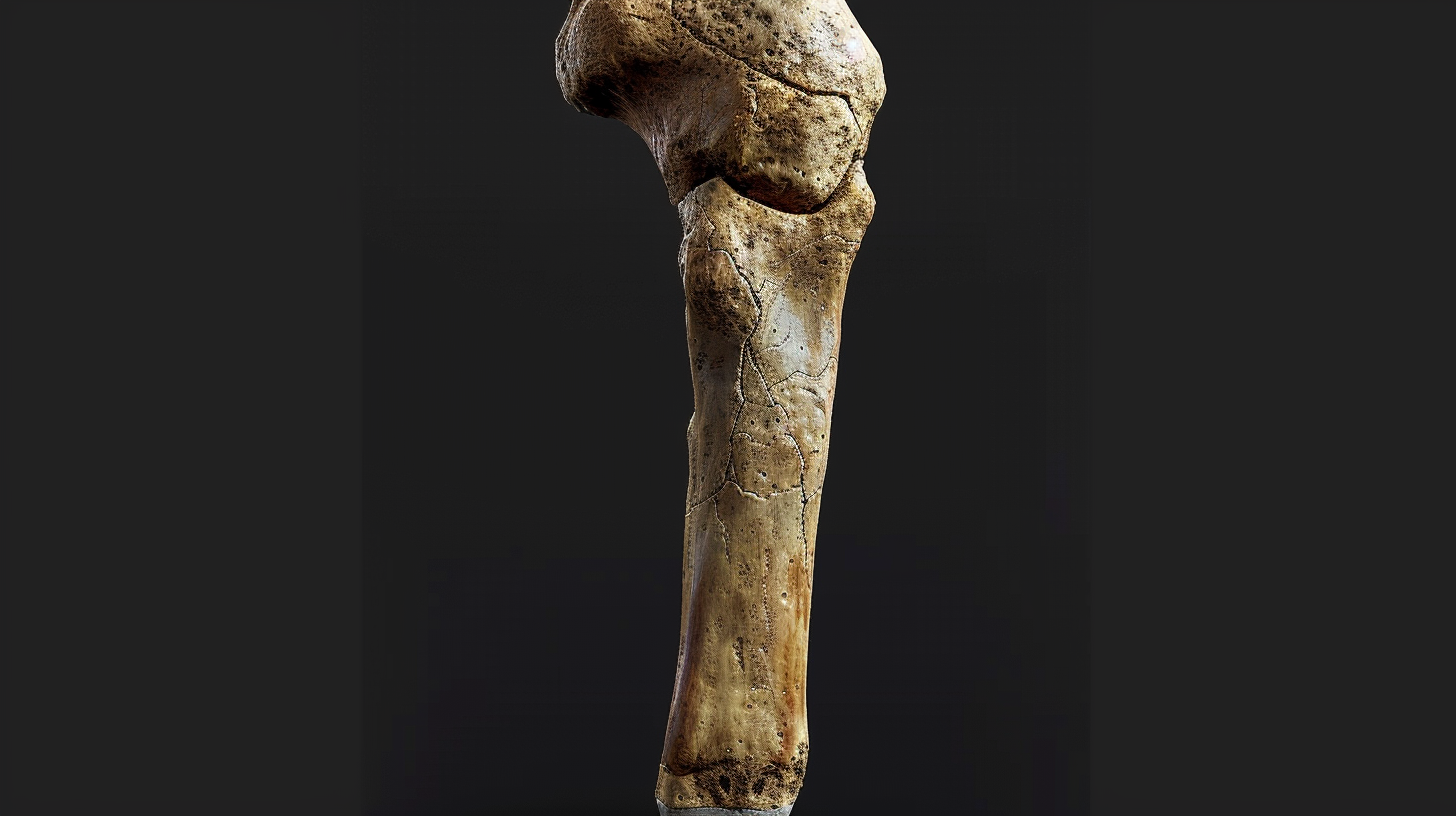
The protagonist of this controversy is a left femur (thigh bone) found alongside the skull in 2001.
- 🚶 “He Walked!” (Pro-Bipedalism): The research team led by Daver discovered a bony structure called the ‘Calcar femorale’ in the upper part of the femur. This is a critical mechanism for supporting body weight while standing. They also argued that the hard outer layer of the bone (cortical bone) was thickened in specific areas like humans, indicating adaptation for two-legged walking.
- 🦍 “No, He Climbed!” (Anti-Bipedalism): On the other hand, Macchiarelli and Cazenave’s teams argued that the angle of the femur is more similar to tree-climbing experts like orangutans than to humans. Furthermore, calculating the ratio of the arm (ulna) to the leg (femur) revealed a body type closer to an ape, with arms longer than legs.
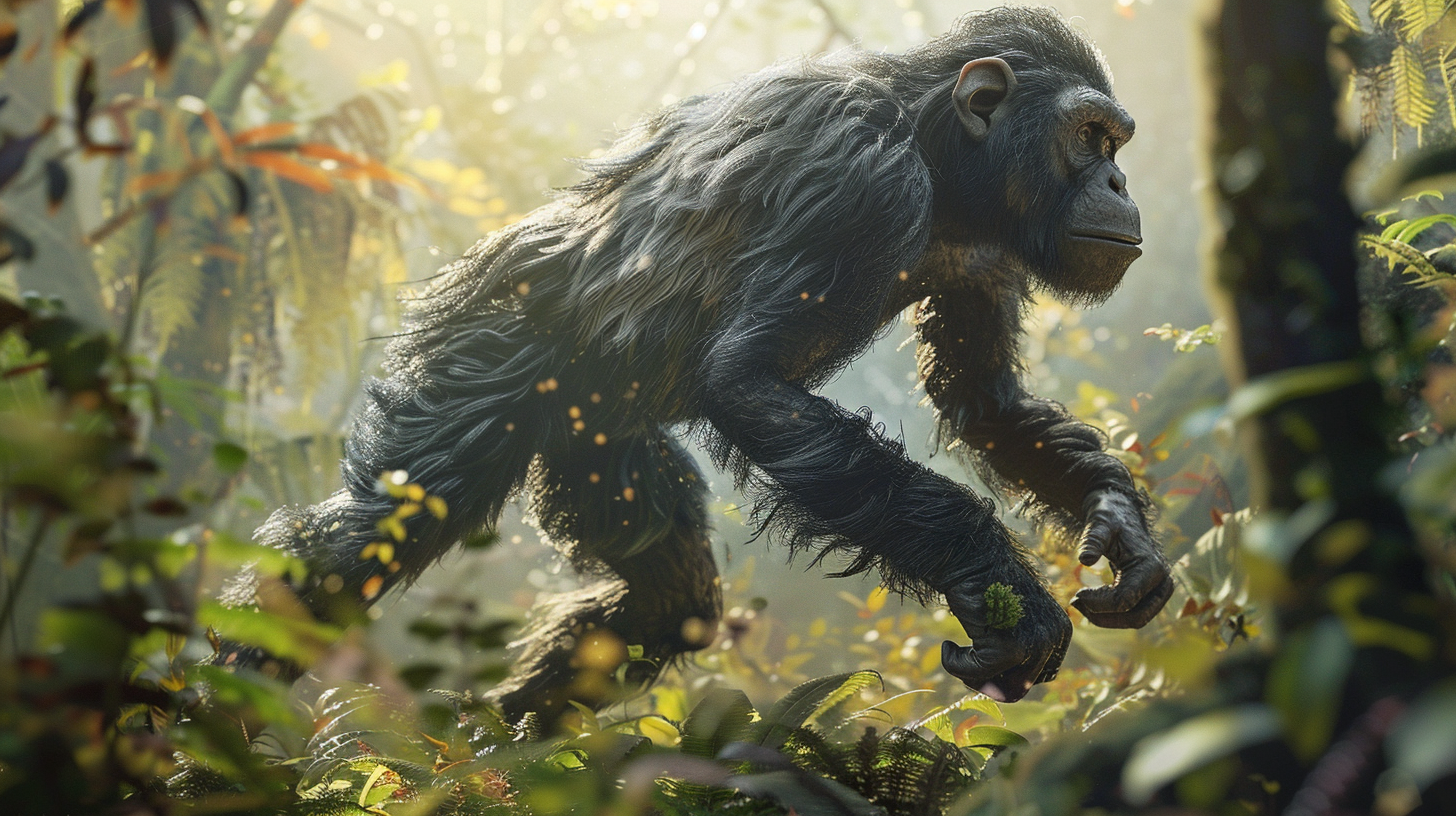
[The Verdict?] The current academic consensus suggests that Toumaï was likely not a ‘perfect biped’. He was a ‘transitional adventurer’ who walked on two feet on the ground but was still adept at life in the trees.
4. Meeting ‘Lucy’: Our Family Tree is Not a Ladder
The famous ‘Lucy’ (Australopithecus afarensis) is an early human from about 3.2 million years ago. Toumaï is an ancestor 3.8 million years older than Lucy.
- Lucy: Had knees and a pelvis already perfectly adapted for upright walking.
- Toumaï: Was at the stage of ‘just starting’ or ‘experimenting’ with bipedalism.
Toumaï’s existence teaches us that human evolution is not a simple ‘ladder’ leading from monkey to man, but a massive ‘Bushy Tree’ where countless branches sprouted and went extinct. Toumaï stands at the very base of that bush, at the fleeting moment when humans and chimps parted ways.
5. Closing: A Greeting Across 7 Million Years
Sahelanthropus tchadensis, or ‘Toumaï’, might not be our direct lineal ancestor. He might be one of the countless ‘cousins’ who tried to become human but eventually went extinct.
However, Toumaï’s legacy is clear. Seven million years ago, in a place where African forests and grasslands mingled, some apes did not hesitate to come down from the trees and stand on two feet. Because of that courageous ‘first step’, we exist today.
Perhaps the name ‘Toumaï’—Hope of Life—is a greeting they are sending to us across 7 million years of time.
References
- Brunet, M., et al. (2002). A new hominid from the Upper Miocene of Chad, Central Africa. Nature, 418(6894), 145–151.
- Brunet, M., et al. (2005). New material of the earliest hominid from the Upper Miocene of Chad. Nature, 434(7034), 752–755.
- Cazenave, M., et al. (2023). Postcranial evidence does not support habitual bipedalism in Sahelanthropus tchadensis: A reply to Daver et al. (2022). Journal of Human Evolution, 179, 103355.
- Daver, G., et al. (2022). Postcranial evidence of late Miocene hominin bipedalism in Chad. Nature, 609(7925), 94–100.
- Lebatard, A.-E., et al. (2008). Cosmogenic nuclide dating of Sahelanthropus tchadensis and Australopithecus bahrelghazali: Mio-Pliocene hominids from Chad. Proceedings of the National Academy of Sciences, 105(9), 3226–3231.
- Macchiarelli, R., et al. (2020). Nature and relationships of Sahelanthropus tchadensis. Journal of Human Evolution, 149, 102898.
- Vignaud, P., et al. (2002). Geology and palaeontology of the Upper Miocene Toros-Menalla hominid locality, Chad. Nature, 418(6894), 152–155.
- Wolpoff, M. H., et al. (2002). Sahelanthropus or ‘Sahelpithecus’? Nature, 419(6908), 581–582.
- Wood, B., & Harrison, T. (2011). The evolutionary context of the first hominins. Nature, 470(7334), 347–352.
- Zollikofer, C. P. E., et al. (2005). Virtual cranial reconstruction of Sahelanthropus tchadensis. Nature, 434(7034), 755–759.