
When you think of the “first civilization,” what comes to mind? You probably think of the Sumerian civilization that bloomed on the fertile land between the Tigris and Euphrates rivers.
Thousands of years ago, in a city called Ur, when a king died, dozens of servants and soldiers followed him to the grave. For a long time, we believed they loved their king so much that they “voluntarily drank poison and were willingly buried alive.”
However, modern forensic science has presented a shocking twist to this romantic myth. Today, we will dig into the splendid history of the Sumerian Early Dynastic Period and the chilling truth hidden beneath it.
1. Dawn of Civilization: Where was the Early Dynastic Period?
Before we explore the mystery, let’s look at the setting. The Sumerian Early Dynastic Period (c. 2900–2350 BC) was a time when “city-states” competed fiercely for the first time in human history.
Shutterstock
탐색
As you can see in the map above, cities like Ur, Uruk, Kish, and Lagash were packed tightly into the Tigris-Euphrates river basin. They were in a constant state of war, fighting each other for land and water.
The reason this era is so great is because of the invention of “records.” Clay tablets, initially used simply to count grain, evolved into tools for recording history and myths. This is the famous Cuneiform script.
2. The History of Kings: Was it Actually “Fabricated”?
The most famous artifact containing Sumerian history is a clay tablet called the ‘Sumerian King List’. It lists rulers from legendary kings before the Great Flood all the way to kings of the historical era. The funny thing is, you shouldn’t believe this record at face value.
Why? This list records history as if “Kingship descended from heaven to City A, and then moved to City B.” It looks as if the dynasties followed a neat, orderly line. However, archaeological evidence shows that, in reality, kings of various cities were grabbing each other by the collar and fighting simultaneously.
In other words, this King List was essentially political propaganda created by later kings to claim, “I am the one and only legitimate king!”
3. Did the King Marry a God? (The Secret of the Sacred Marriage)
Kings of this era performed a very special ritual to maintain their power. It was the ‘Sacred Marriage’.
We commonly know this as a sexual union between the king and a high priestess to pray for fertility. However, recent scholars interpret this more politically. The ritual of the king uniting with a goddess (usually Inanna) was not just a simple prayer for blessings, but a process of “the king receiving secret knowledge (statecraft, strategy) known only to the gods.” In other words, it was a symbol of authority declaring, “I have been chosen by the gods and have obtained wisdom.”
4. What Was Their Daily Life Like? (The Great Household Economy)
While kings were busy with wars and rituals, how did ordinary people live? Society in this era operated under a system called the ‘Great Household’. Huge temples or palaces functioned like one giant corporation.
- Jobs: There were various professions, including farmers, herders, fishermen, brewers, and bakers.
- Economy: People belonged to temples or palaces, worked for them, and received food (barley, oil, wool, etc.) as rations in return. The countless bowls found in the tombs of Ur demonstrate the culture of communal dining (rationing).
5. [Shocking True Story] The Truth of the Royal Tombs of Ur: The Betrayal of the Beautiful Burial
Now, for the highlight of today’s story. In the 1920s, archaeologist Leonard Woolley excavated the Royal Cemetery of Ur and was astonished.
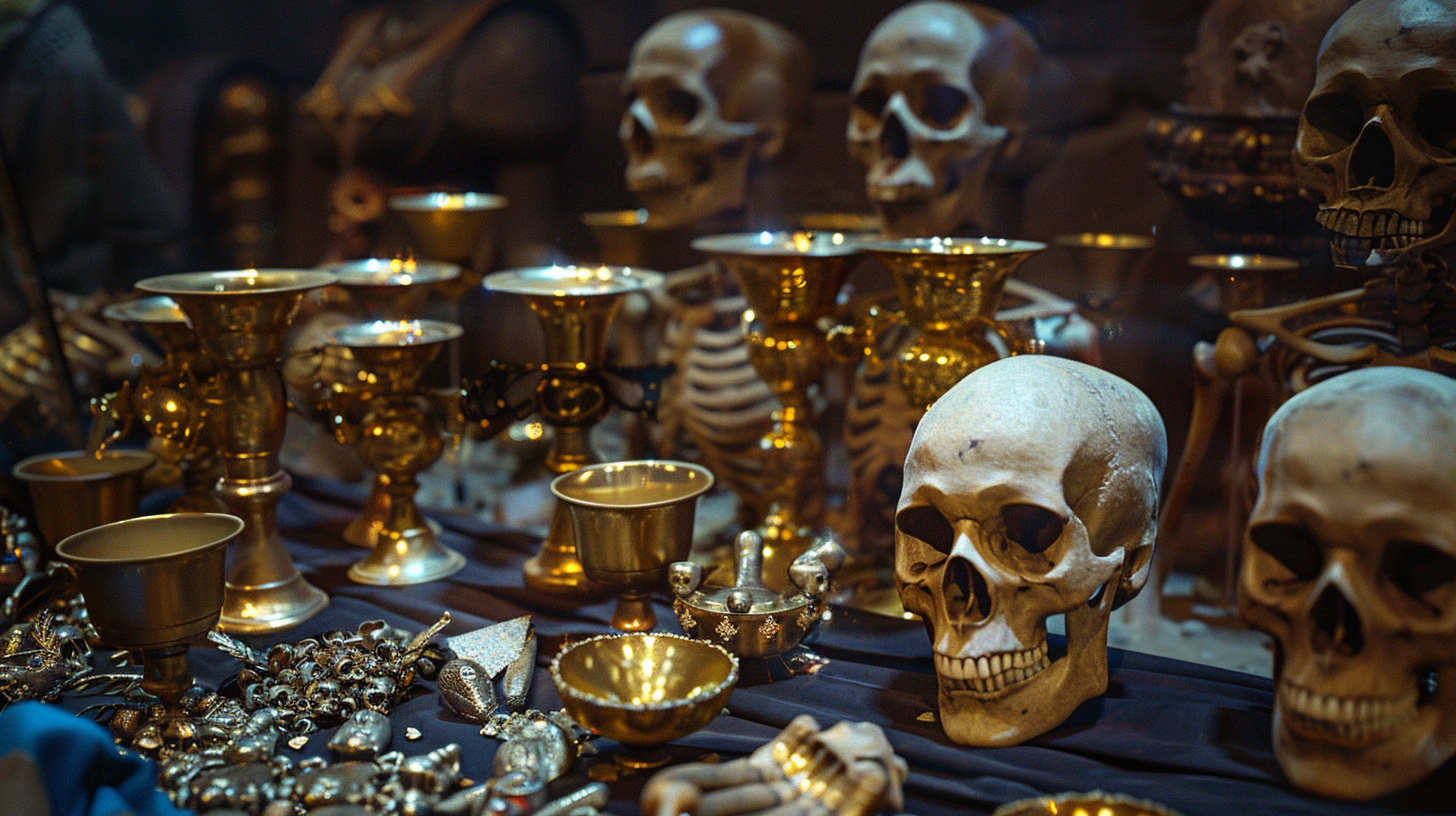
Inside the tombs, alongside splendid gold helmets, elaborate lyres (instruments), and jewelry, dozens of attendants lay in orderly rows. Seeing how peaceful the bodies looked, Woolley claimed, “They voluntarily drank poison and fell asleep to serve their king.”
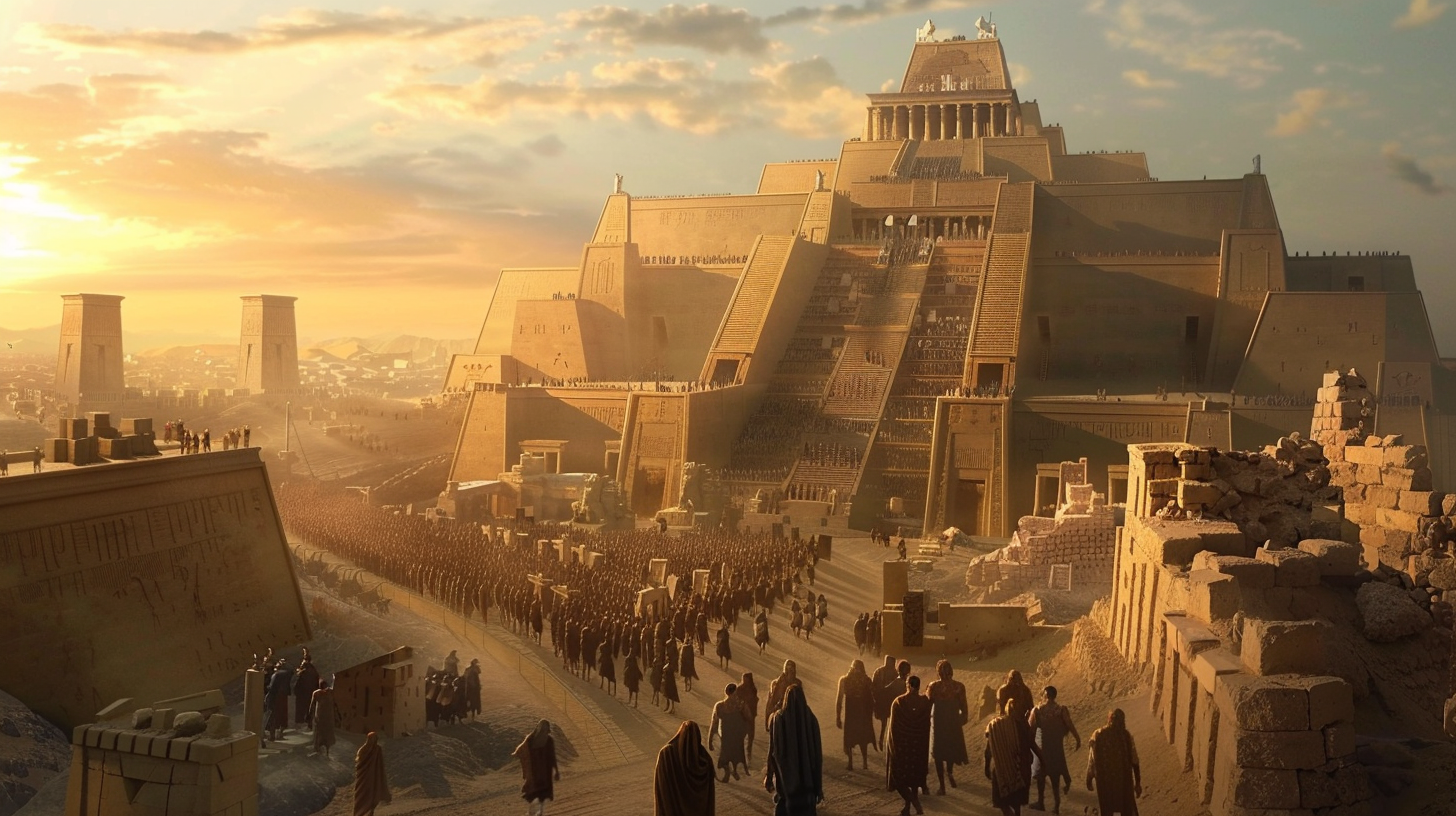
(The Ziggurat, the symbol of Ur. What truth lies buried beneath this massive tower?)
However, in the 21st century, modern CT scans and forensics shattered this romantic hypothesis.
- Homicide by Blunt Force: Analysis of the attendants’ skulls revealed that they didn’t die from poison, but from being struck on the head with blunt weapons like axes, leaving fracture marks (holes).
- Post-Mortem Processing: Traces were found indicating the bodies were heated (burnt) after death and treated with mercury for preservation. This means they didn’t die at the funeral site; they were executed elsewhere, then moved to the tomb and arranged (displayed) prettily.
Why on earth didn’t they resist? Scholars believe the secret lies in ‘Feasting’.
(The ‘Peace’ panel of the Standard of Ur. Was this peaceful-looking banquet actually a rehearsal for death?)
The photo above is the famous ‘Standard of Ur’. It shows people holding cups and enjoying a banquet. Scholar Susan Pollock analyzes that because these people were accustomed to the roles performed at banquets in their daily lives (holding cups, standing in line, playing instruments), they docilely followed orders to meet their deaths under the guise of a “Final Feast.” It is a terrifying glimpse into how power can control human beings.
6. Conclusion: A Legacy Shining Brighter than Gold
The Sumerian Early Dynastic Period is remembered for its splendid gold artifacts, but its true essence lies in the birth of a massive system called the ‘State’.
- Distortion of History: Kings edited history for their own power.
- Politics and Religion: They monopolized governance knowledge through the Sacred Marriage.
- Control and Violence: They were able to control their subjects even unto death through the culture of feasting.
What was found in the Royal Tombs of Ur wasn’t just simple treasure; it might have been the bare face of the powerful and ruthless authority that humanity created for the first time.
References
- Baadsgaard, A. (2011). Human sacrifice and intentional corpse preservation in the Royal Cemetery of Ur. Antiquity, 85(327), 27–42.
- Devi, J. M. (2025). Reconstructing Ancient Societies Through Inscriptions. Historical Research: Journal of History and Archaeology, 3(2), 34–36.
- Frayne, D. R. (2008). Presargonic Period (2700–2350 BC) (Royal Inscriptions of Mesopotamia, Early Periods 1). University of Toronto Press.
- Jacobsen, T. (1939). The Sumerian King List. The University of Chicago Press.
- Kramer, S. N. (1963). Cuneiform Studies and the History of Literature: The Sumerian Sacred Marriage Texts. Proceedings of the American Philosophical Society, 107(6), 485–527.
- Marchesi, G. (2011). Royal Statuary of Early Dynastic Mesopotamia (Mesopotamian Civilization 14). Eisenbrauns.
- Pollock, S. (2007). The Royal Cemetery of Ur: Ritual, Tradition, and the Creation of Subjects. In M. Heinz & M. H. Feldman (Eds.), Representations of political power (pp. 89–110). Eisenbrauns.
- Pongratz-Leisten, B. (2008). Sacred Marriage and the Transfer of Divine Knowledge. In M. Nissinen & R. Uro (Eds.), Sacred marriages: The divine-human sexual metaphor from Sumer to early Christianity (pp. 43–74). Eisenbrauns.
- Sallaberger, W. (2015). Conclusion. In W. Sallaberger & I. Schrakamp (Eds.), ARCANE 3: History & Philology (pp. 297–304). Brepols.
- Woolley, C. L. (1934). Ur Excavations II: The Royal Cemetery. The British Museum and the Museum of the University of Pennsylvania.