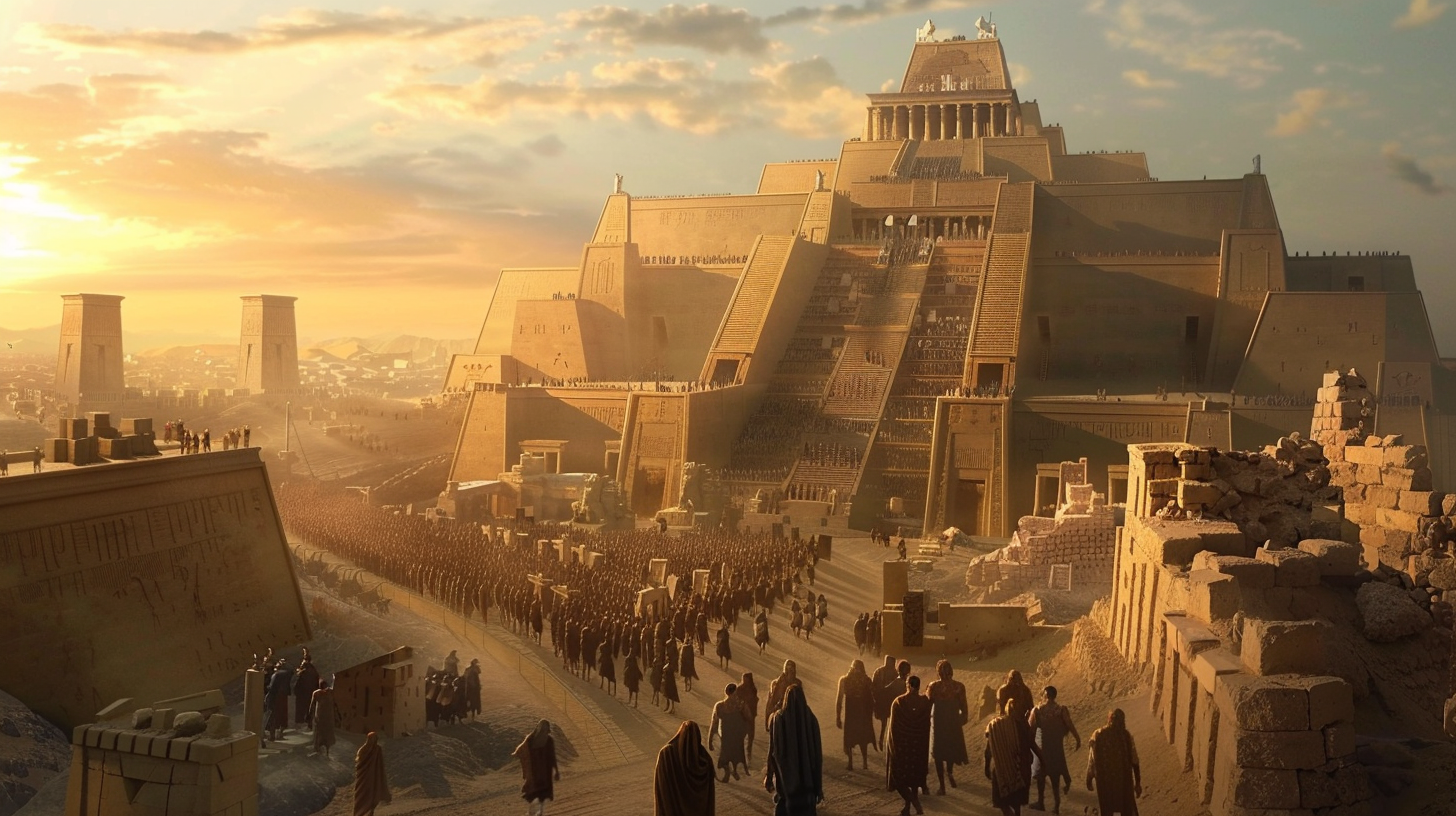

When we think of “empires,” Rome or the Mongols often come to mind. However, long before them, from the 9th to the 7th century BC, there was a people who dominated the entire Middle East and established the “first true empire in human history.” They were the Neo-Assyrian Empire.
Assyria is often known merely as a cruel conqueror in the Bible. However, according to the latest research, they were not simple destroyers. They were a civilized nation with a highly sophisticated administrative system, libraries, and magnificent art.
Today, based on 12 of the latest academic papers, we uncover the true face of Assyria.
1. The Giants Who Built the Empire: A Chronicle of 5 Great Kings
The history of Assyria is the history of its conquering monarchs. To understand the empire, you must know these five “superstars” who led its golden age.
- Tiglath-Pileser III (745–727 BC): The Architect of the empire. He reformed a disorganized military into a ‘standing army’ (professional soldiers), turning Assyria into a war machine.
- Sargon II (721–705 BC): The Builder King. To cover up the controversy surrounding his usurpation of the throne, he waged ceaseless wars of conquest and built the new capital city, ‘Dur-Sharrukin,’ to show off his majesty.
- Sennacherib (704–681 BC): The King of Destruction and Transfer. He thoroughly destroyed the rebellious Babylon and moved the capital to Nineveh, growing it into the largest city of its time. He is the very king who attacked King Hezekiah in the Bible.
- Esarhaddon (680–669 BC): The Apex of the empire. Although he ascended the throne amidst the chaos of his father’s (Sennacherib) assassination, he became the only Assyrian king to conquer Egypt, securing the largest territory in the empire’s history.
- Ashurbanipal (668–627 BC): The Scholar King. Loving the pen more than the sword, he built the first library in human history and collected knowledge from all over the world. However, after his death, the empire went into rapid decline.
2. Hard Power: Why Were They So Cruel? (The Politics of Terror)
The Assyrians left behind reliefs (murals) depicting them flaying captives alive or impaling them on stakes. Was this simply because they were barbaric?
According to research by scholar Weijia Chen, this was a calculated ‘Terror Tactic.’
- Psychological Warfare: By visually displaying the message “Surrender and live, or resist and suffer this fate,” they employed a strategy to win without fighting.
- Mass Deportation: They forcibly relocated elites and technicians from conquered lands to the Assyrian heartland with their families. This was a sophisticated population boosting policy that nipped rebellions in the bud while filling the empire’s labor shortages.
3. Assyria and the Bible: The Fate of Jerusalem
Many people first encounter Assyria through the Bible (Old Testament). How do historical records differ from the biblical account of the same event?
- The Siege of Lachish and Jerusalem:
- The Bible (2 Kings): Records that Sennacherib besieged Jerusalem, but an angel of the Lord appeared at night and struck down 185,000 Assyrian soldiers.
- Assyrian Record (Sennacherib’s Prism): Records the victory, stating, “I shut up Hezekiah the Judahite like a bird in a cage… He sent me 30 talents of gold and 800 talents of silver.”
- The Fact: It is true that Assyria failed to capture Jerusalem. However, the Kingdom of Judah survived only by paying a massive tribute, while its strategic outpost, ‘Lachish,’ was brutally conquered. (The Lachish relief at the British Museum vividly shows the brutality of that time.)
- Jonah’s Nineveh: The massive “city of evil” where the prophet Jonah went to cry out for repentance was none other than ‘Nineveh,’ the capital built by Sennacherib.
4. Soft Power: Knowledge is Power
It is a mistake to think Assyria ruled only by the sword. They were masters of Knowledge and Administration.
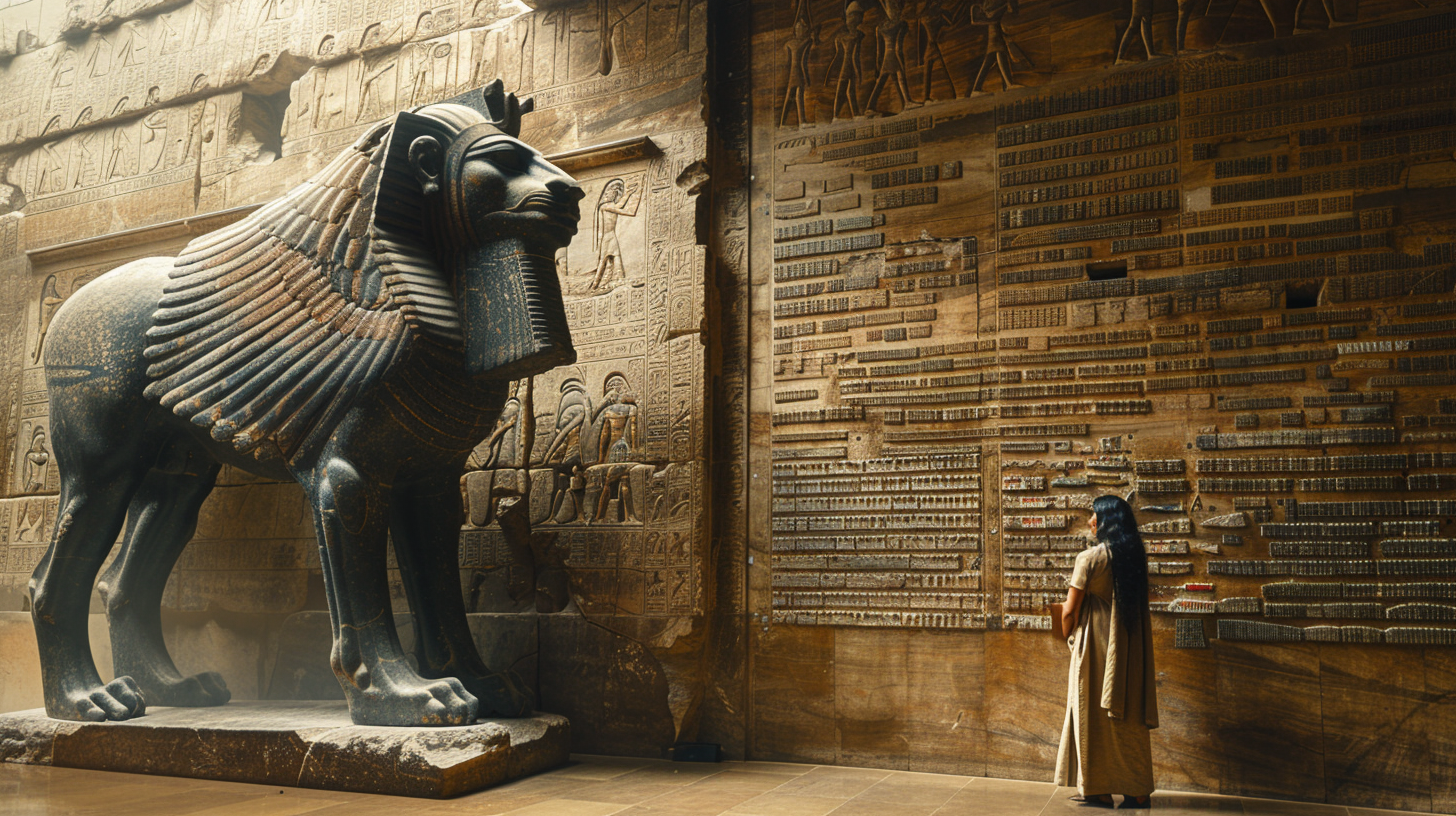
- The First Library in History: King Ashurbanipal boasted, “I can read the complex texts of the gods written on clay tablets.” He collected over 30,000 clay tablets covering literature, medicine, history, and astrology in the Library of Nineveh. This is the first known instance of a system featuring ‘classification’ and ‘cataloging,’ much like modern libraries.
- Astrology as Science: According to Professor Francesca Rochberg’s research, for the Assyrians, astronomical observation was not superstition but data science for national security. The king received daily reports on the movements of the stars from scholars and decided on war and diplomacy based on this data.
5. Art and Daily Life: Lamassu and the Lion Hunt
Assyrian art is famous for its overwhelming scale and detail.
- The Guardian with 5 Legs, Lamassu: The massive stone statues guarding the palace gates, ‘Lamassu,’ have a human head, a bull’s body, and eagle’s wings. The peculiar thing is that they have five legs.
- The Secret: From the front, they appear to be standing firm on two legs to block intruders; from the side, they appear to be walking vigorously on four legs. It was an ancient 3D technique designed to look perfect from any angle.
- The Lion Hunt: Assyrian kings enjoyed lion hunting. This was not merely a sport, but a religious ritual symbolizing ‘The King subduing Chaos (the lion) and protecting Order (the empire).’
- The Lives of Queens: Tombs of queens were discovered beneath the palace at Nimrud. The tens of kilograms of gold jewelry and gems found there demonstrate the immense wealth of the empire and the status of royal women.
6. Conclusion: The Empire That Was Forgotten But Did Not Disappear
In 612 BC, Nineveh, which seemed eternal, burned and fell to the Babylonian-Median alliance.
However, Assyria did not disappear. The road systems, administrative districts (provinces), royal protocols, and imperial ideology they created were inherited intact by the subsequent Persian Empire. Assyria was humanity’s first grand experiment in managing the world by combining military force with knowledge.
References
- Curtis, J. (Ed.). (2005). Forgotten Empire: The world of Ancient Persia. British Museum Press.
- Frahm, E. (Ed.). (2017). A Companion to Assyria. Wiley Blackwell.
- Radner, K. (2015). Ancient Assyria: A Very Short Introduction. Oxford University Press.
- Rochberg, F. (2016). Before Nature: Cuneiform Knowledge and the History of Science. The University of Chicago Press.
- Bedford, P. (2001). Empire and Exploitation: The Neo-Assyrian Empire. (Draft). Social Science History Institute, Stanford University.
- Chandra, B. K. (2023). Early Tales of Library: Assyrian Library. ATHENA, 7, 90–96.
- Chen, W. (2020). The Assyrian Empire: Terror Tactics as a Tool of Empire-building. (Unpublished master’s thesis). National and Kapodistrian University of Athens.
- Frame, G. (2023). The Royal Inscriptions of Sargon II, King of Assyria (721–705 BC) (RINAP 2). Eisenbrauns.
- Leichty, E. (2011). The Royal Inscriptions of Esarhaddon, King of Assyria (680–669 BC) (RINAP 4). Eisenbrauns.
- Maul, S. M. (2017). Assyrian Religion. In E. Frahm (Ed.), A Companion to Assyria (pp. 336–358). Wiley Blackwell.
- Merrillees, P. H. (2023). Ancient Near Eastern Seals: Enduring Envoys. DOI: 10.62614/z39nv251.
- Parpola, S. (1987). Neo-Assyrian Treaties from the Royal Archives of Nineveh. Journal of Cuneiform Studies, 39(2), 161–189.